
Send this article to a friend:
January
16
2026
|
Send this article to a friend: January |
How Currency Stress Is Pushing Gold, Silver to New Highs
Gold moves towards $4,600, silver approaches $90 – what’s going on? Researchers' perspective into why silver is doing so well The Venezuela affair is probably going to end up benefitting gold Two and a half years of weekly all-time highs in the gold market? (Sure feels like it)As Bloomberg reported, the most recent reports are having trouble keeping up with gold's gains. The above article is written by an analyst from Singapore, whose timezone is 13 hours ahead of Eastern Time. For them, the market is open almost a full day ahead of the New York spot maket on Sunday, and they've been watching gold soar. Gold’s price as $4,561 as of 8:23 AM Singapore time. Just 30 minutes later, it stopped $1 short of $4,600. (We've seen these kinds of unnatural stops for the entirety of silver's current run, whether you call them “psychological levels” or “profit-taking” or whatever. Gold traded around $4,590 almost from the moment Asian markets opened, while silver has hit some kind of resistance around $83. Some three years back, I pointed out that even gold investors shouldn't want the price of gold to rise too high because it will mean something has gone very wrong with their currencies. As I said back then, strong gold means weak U.S. dollar. Structurally weak, I mean, not in terms of the dollar index which just measures relative strength or weakness vs. other currencies. Admittedly, when I wrote that, I admit I wasn't expecting gold to move so much in so little time. Back then, I was expecting silver to reach a minimum of $70 with a gold price of around $2,500. That would have been "normal," based on historical precedent. Back then, if I’d told you “Gold’s price will triple in the next 2-3 years,” you would’ve laughed at me. Such a claim would’ve rightly drawn the ridicule and contempt of many. Funny how events unfold, isn’t it? I thought $2,500 gold was bad news for the U.S. dollar. So what does that tell us about gold surging to $4,600 with little resistance? Then we look at silver – which tends to trail gold, then outperform gold in bull markets. Silver has clawed back over the last few days, now going for $85 – likely next to $90. Even $100 is now in view, triple digit silver, and who knows what follows that? Nobody knows. The forecasters at big banks can't seem to make sense of what's happening. HSBC, for example, says gold will hit $5,050 in the first half of 2026, not the second half… But then endure a severe correction. Okay – whenever someone says gold’s price will fall, ask this follow-up question: “To where?” Technically, a “correction” means a 10% price drop over an unspecified timeframe. At today’s numbers, that puts gold comfortably over $4,000… If you’ve owned gold for more than a year, that’s a comforting number, isn’t it? Regardless, HSBC’s analysts don't say where the correction will go.They DO say the average gold price for 2029 is $4,775. Clearly, that correction they forecast it temporary! These days, big banks have no problem projecting a $5,000 gold price in 2026. As I referenced previously, UBS, Saxo Bank and Bank of America have all forecast $5,000 gold – and HSBC has joined their ranks. This is good news for gold investors, central bank gold stockpiles, probably mints and sound money enthusiasts too. An awful lot of other institutions (and investors!) are having to contend with some very harsh facts about currencies. What is going on is starting to look like a full-blown currency crisis. I’m not talking about the dollar explicitly – about all unbacked currencies. I can't remember any time in my life when there was so much financial and economic uncertainty. The fundamentals that are driving silver higherBrownstone Research released quite the overview of silver, although I still feel like they've left important details out. In reading their article, one might get the idea that silver needed industrial demand, COMEX squeezes and so on to hit $100. I believe it doesn't. Silver doesn't need a single thing but free and fair trading to hit $100 with a $4,600 gold price. That is almost a 50-to-1 gold/silver ratio, which would have been seen very elevated for most of history. [Update: as of January 14, the gold/silver ratio hit 51 with gold at $4,600 and silver at $90.] That's not to take away from Brownstone, of course, as the drivers they listed are undoubtedly pushing prices higher already. Ultimately they’re what could enable silver to hit $200 and up in this cycle. Brownstone echoes several of my points. Most importantly, that silver isn't going up or down based on minute-to-minute news and is instead rising simply on market structure, on supply and demand.
I'd say I couldn't have said it better myself. But I have said it myself, and you might actually be tired of hearing me say it… The article is chock-full of interesting data. Here are some highlights... The authors report that, to buy silver bullion in South Korea, you’ll pay $130/oz. Europeans, who are mostly blessed with a sales tax exemption for gold, don’t get the same for silver. That means silver costs something like 30% over spot not counting premiums. So a 1 oz silver coin or bar will run you $130+ in Paris or Berlin. We already know that real physical precious metal always costs more than spot price – what’s less appreciated is just how much more individual savers are willing to pay for it. The article says that silver is the centerpiece of the next industrial cycle, which is true enough. (Arguably it's been there for a while now.) Brownstone thinks the current rate-cutting cycle and inflation fears are driving investors toward inflation-resistant physical assets. Fair enough. But where is the silver going to come from? Brownstone asks the same thing and is no closer to an answer than I am. A 149 million ounce deficit in 2024 in a market where only 30% of supply comes from silver mines (the rest as a byproduct of mining lead, zinc, copper – base metals). On top of all this, China, a top silver exporter, doesn't want to export silver anymore. MarketWatch tells us China has been exporting 60-70% of the world’s global refined silver supply! That’s why Elon is freaking out on social media… UBS recently said that silver might reach triple digits. Considering the massive industrial demand and these supply disruptions, triple-digit silver seems all but guaranteed in the months ahead. Will Venezuela trigger another wave of central bank gold buying and repatriation?As seen on City AM, the Bank of England might make the same overreach that the West did with Russia as eyes fixate on the Venezuelan gold it holds. One might say that the damage has already been done. Besides the humanitarian crisis, Venezuela's gold bullion is coming up as the top story in this debacle. Is anything besides those two points really relevant? As you probably know, when Russia was cut off from SWIFT, central banks around the world said: "I don't wanna find myself there". And we now have 1,000 ton a year central bank purchases almost as sure as the sun rising. Even though the U.S. takes credit for toppling Maduro's government, President Trump's White House implicitly supports Delcy Rodriguez, Maduro's deputy. The BoE, on the other hand, has exclusively supported the opposing regime of Juan Guaido since 2018, and has refused to release the gold to Maduro for six years. This is very important because Maduro, not Guaido, was in charge of the central bank. Just as central banks didn't care that Russia was wrong to attack Ukraine, they probably won't care whether Maduro or Guaido had the better claim to presidency. What central bank, and why, will want to hold gold abroad if it can essentially be stolen because the offshore, super-safe, super-neutral vault no longer "recognizes" it? We've seen hundreds of tons being repatriated in recent times, closer to thousands really, with Germany and Italy being two prominent examples. It would be very naive to think that this wasn't spurred by views from Venezuela. The trend of repatriations will no doubt continue. But will it accelerate, and more importantly, will the foreign vaults be able to ship the gold when asked? In today's world of perpetual gold and silver physical squeezes and broad accusations of undocumented gold leasing, repatriations are probably feared by more than a few vaults. I’m watching these stories as they develop. And I keep returning to the the question of why central banks care so much about that “old-fashioned” and “obsolete” form of money they've ignored and talked down for the last 50 years. The real answer, the one no central banker would ever admit out loud, might be: “Gold is too important for citizens to have, so let the professional central bankers stockpile it instead.” Forgive my skepticism. Personally, I think gold is too important for governments to have it all. I’ll have to agree to disagree with the world’s central bankers. .
|
Send this article to a friend:
 |
 |
 |
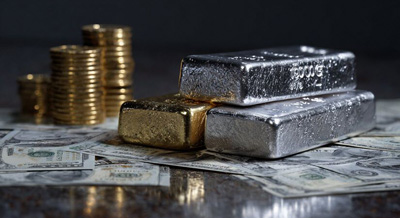 Gold’s move toward $4,600 isn’t about jobs data or geopolitics – it’s about currency stress. Silver’s tightening supply tells the same story, while Venezuela’s gold dispute shows why central banks demand physical metal stored close to home…