Trump's Gunboat Diplomacy Triggers Sharp Drop In Venezuelan Oil Output
Tyler Durden
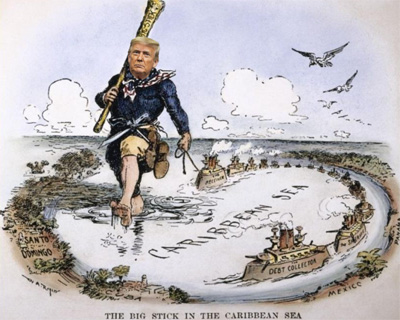 President Trump’s gunboat diplomacy in the Caribbean, designed to disrupt and dismantle Venezuelan oil flows to Asia in order to choke off the Maduro regime’s primary revenue stream and induce regime instability in Caracas, is now moving full steam ahead, as confirmed by the latest crude oil export data. President Trump’s gunboat diplomacy in the Caribbean, designed to disrupt and dismantle Venezuelan oil flows to Asia in order to choke off the Maduro regime’s primary revenue stream and induce regime instability in Caracas, is now moving full steam ahead, as confirmed by the latest crude oil export data.
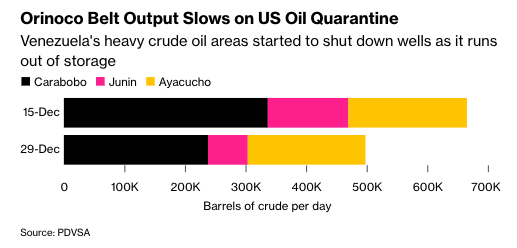
Bloomberg cites new internal data from Petróleos de Venezuela showing that oil production in the Orinoco Belt (which accounts for nearly two-thirds of Venezuela’s oil output) plunged by about 498,000 barrels per day on Monday, down roughly 25% over the past two weeks.
In recent weeks, Trump's gunboat diplomacy has ramped up with multiple seizures of dark fleet tankers, offshore blockades, and sanctions against additional tankers that haul Venezuelan crude to China. The aim is to suppress Maduro's cash flows, since more than 95% of the country’s revenue depends on oil sales.
"While military options still exist, the focus is to first use economic pressure by enforcing sanctions to reach the outcome the White House is looking (for)," a U.S. official told Reuters last week, speaking on condition of anonymity.
The Trump administration is enforcing a two-month "quarantine" of Venezuelan oil, which may indicate the time needed to create immense financial pressure on Maduro and could lead to regime instability. If Caracas falls, Cuba would likely follow quickly.
Related:
China condemned Trump’s gunboat diplomacy in the Caribbean as illegal “unilateral bullying.” In response, Beijing aired a simulated war scenario on state television set in the Caribbean region.
 our mission: our mission:
to widen the scope of financial, economic and political information available to the professional investing public.
to skeptically examine and, where necessary, attack the flaccid institution that financial journalism has become.
to liberate oppressed knowledge.
to provide analysis uninhibited by political constraint.
to facilitate information's unending quest for freedom.
our method: pseudonymous speech...
Anonymity is a shield from the tyranny of the majority. it thus exemplifies the purpose behind the bill of rights, and of the first amendment in particular: to protect unpopular individuals from retaliation-- and their ideas from suppression-- at the hand of an intolerant society.
...responsibly used.
The right to remain anonymous may be abused when it shields fraudulent conduct. but political speech by its nature will sometimes have unpalatable consequences, and, in general, our society accords greater weight to the value of free speech than to the dangers of its misuse.
Though often maligned (typically by those frustrated by an inability to engage in ad hominem attacks) anonymous speech has a long and storied history in the united states. used by the likes of mark twain (aka samuel langhorne clemens) to criticize common ignorance, and perhaps most famously by alexander hamilton, james madison and john jay (aka publius) to write the federalist papers, we think ourselves in good company in using one or another nom de plume. particularly in light of an emerging trend against vocalizing public dissent in the united states, we believe in the critical importance of anonymity and its role in dissident speech. like the economist magazine, we also believe that keeping authorship anonymous moves the focus of discussion to the content of speech and away from the speaker- as it should be. we believe not only that you should be comfortable with anonymous speech in such an environment, but that you should be suspicious of any speech that isn't.
www.zerohedge.com
|