
Send this article to a friend:
January
23
2026
|
Send this article to a friend: January |
Gold Rises as Currency Cracks Widen – the Great Repricing Continues
Another very busy week in the gold market It was a novelty to read Bridgewater's Ray Dalio explain that gold's gains are actually a story about currency decay. Dalio is now becoming the voice of reason. He’s been remarkably consistent in his warnings over the last five years or so… And investors finally seem to be listening. Most analysts are desperate to find an alternate explanation for gold's run so far. Some great black swan, or the accumulation of hundreds of smaller economic events. Anything rather than the most glaringly obvious answer. As Dalio notes, gold was the best asset of 2025, returning 65% in U.S. dollar terms. (It returned a lot more in many other currencies.) Remember that gold is often derided as an asset because it "doesn't generate a yield." As Dalio noted, other asset classes only posted a return if you bought them using a declining currency. (Even then, a comparatively meager gain.) On the other hand, if had you used real money (gold) to buy risk-on assets, you’d be down about 28%, even though their returns were technically in the green. See, when a currency is being destroyed, it doesn’t really matter what you spend it on. It reminds me of Devon Zuegel’s explanation of how folks used to “save” in Argentina:
When saving in currency is this bad, almost anything else can be a winning asset. Even bricks! Speaking of currency destruction, President Trump has launched a criminal probe into Fed Chair Jerome Powell, via Bloomberg. Yes, there’s something of a war between the White House and the Federal Reserve. Even though we think of the Fed as part of the government, the Fed was, is, and will likely remain an independent and privately-chartered organization. (Don't ask me how that works.) I don’t really think there’s much point in accusing Powell of crimes (especially trivial transgressions like misrepresenting the cost of a building restoration). The Fed has never been and will probably never be accountable to the federal government. But that story – framed as “an attack on the Fed’s independence” – along with the protests in Iran and the imminent seizure of Greenland – all are cited as reasons for the huge surge in the price of gold. Gold has climbed just short of $4,700 as of latest counting, another massive weekly gain. Most big banks have scuttled any 2026 price forecast below $5,000 in regards to forecasts, which now seems to be the next target. What makes this run especially interesting, as I've repeatedly stated, is that investors in other assets always have to worry about "the party being over." That's the thing with partying. You have a late night up and pay for it tomorrow. But that's not the case with gold, and it hasn’t been for the last eight years or so. In fact, we don’t really have a model to explain what a downward correction for gold might look like. For example: Gold's biggest fall in modern times was $1,910 to $1,150 after 2011. Looks bad! But it still left gold massively above its $200-400 starting point, depending on where say it began its 2000s run. There was the 2015 bottom, from which gold sharply bounced back and was again trading towards $1,500-$1,600 in a few years. A loss gold more than made up for in a single year (2025). In other words, if gold corrects, I think the new bottom would be $3,500-$4,000. A pretty severe drop from today’s price! At the same time, more than double its price of just a couple years ago. This is why I say that these are the most exciting times to be a gold investor in 50 years, and why the idea of missing the boat no longer seems to apply to precious metals. Higher highs and higher lows. (At least when measured in terms of a decaying currency.) As silver approaches $100, the negative forces are being felt Silver passed $90 and then set its sights to $100 in short order, albeit encountering some resistance along the way. It's still above $90, which is remarkably positive, but I'm seeing some pretty strange analyses that are telling me the damage control crew is starting to set in. The damage, of course, being silver above $100 and possibly moving to $200. I read an extensive piece on Substack that assured us CME Group isn't trying to cover ground by raising margin hikes to make silver speculation less feasible. Even stranger was reading elsewhere that silver faces a "brutal selloff", through no fault of its own but as part of a $6.8 billion commodity index rebalancing. If the second sounds like fearmongering to you, you're on the right track. As most U.S. states now agree once again, silver isn't a commodity, but rather money. That it happens to be used in industry is good for silver holders, but doesn't change its primary role, or we wouldn't have legislation calling it legal tender. Nobody's saying gold's use in electronics makes it a commodity, do they? Well, not that often. Furthermore, silver, as I've repeatedly pointed out, faces a structural deficit of 200 million ounces a year. What possible sense does it make, given these fundamentals, for it to be swept and sold off with other commodities that have totally different supply and demand dynamics? Copper and lumber were never money, and you can't buy sales exempt coins of either. So I believe we are seeing the innings of some kind of attempt, whether orchestrated or not, to claim that silver is too high and to justify any possible selloffs. Similar to gold, many major firms have adjusted their forecasts, with Sprott targeting $106 silver this year. Yet it's as if every headline has a "but" to it, or something like that. Silver's road up was much harder than gold's, to put it mildly. And even now, when we are what one might call halfway there, it's clearly being pushed down from a sentiment standpoint. I've seen a lot of takes on silver in recent weeks, but not many arguing for $150 or $200 silver. Why, when such targets absolutely do make sense relative to gold's price and with any other gauge you can think of? Throughout various points in modern history, the gold/silver ratio was below 20, when silver's fundamentals were nowhere near what they are now. That means it took less than 20 ounces of silver to buy an ounce of gold. I use this as a precursor to saying that silver's $100 is gold's $2,000. But why are we talking about silver's $100 when gold is nearly $4,700? Anyways, everyone's making a big deal out of $100 silver just as they did with $2,000 gold. To a degree, with good reason, as the psychological impact is massive. In case you weren't around, the $2,000 gold level that was talked about for over a decade ended up being a totally insignificant resistance that gold blazed through. It does feel that silver is in a similar situation now. If it clears $100, is it really going back to $34? Who's going to justify that, and how? It seems more likely that, similar to gold, it will start trading above that, with the resistance level as ground. So just as the past few weeks have been the most exciting for gold and silver investors in 50 years, the next few promise not to disappoint in that regard. Will silver be able to have the same readjustment that gold had, or is the price manipulators' sway too great in the absence of a Basel III to help move things along? The good news is that with a few dollars off, there's no argument to claim that silver needs gold to be $5,000 before it reaches $100. Any slight move up in gold can be used as reason enough for silver to reach $100. If it does, we could easily find ourselves forgetting about two-digit silver just as we have $2,000 gold. Van Eck: A return to sound money would set gold’s price as high as $184,211/oz. Van Eck is a global portfolio management firm overseeing $181 billion of assets. That’s an important consideration for this discussion. In other words, the following analysis wasn't posted to social media by a gold fanatic from deep inside his doomsday bunker. It was made by a team of specialists focused on generating profits irrespective of asset classes. In other words, not particularly biased – Van Eck works with all kinds of asset classes, from unusual fringe investments to thematic funds, based in the U.S. and around the world. So what do they have to say? Van Eck did some calculations on gold's price if it was reinstated as the global reserve asset. (As if it ever lost that role.) They used hard data, assessing gold price based on governments’ currency liabilities and their gold reserves with 2 scenarios: One which uses base money, and one broad money. “Base money” includes only cash and central bank deposits. “Broad money” includes money market funds and savings deposits. Their minimum scenario left them with a gold price of $39,210. Factoring in broad money, the price of gold would be $184,211. (My own calculations, which are somewhat dated now, put the price of gold at $80,000 in this scenario – so, because I did my own math, I understand how they got to these relatively shocking numbers.) That looks unbelievable, right? Well, it looks even more unbelievable for any country that is deeply indebted, or has a badly-inflated currency. Even first-world nations would face a higher gold price, like $300,000 for the U.K. or $400,000 for Japan. I haven't covered these kinds of analyses in a while because frankly there’s been no need. More specifically, I have covered them, but they fall under "what gold did last week." But this one is particularly interesting for several reasons, starting that it comes from such a large investment firm that’s much more diversified than, say, Birch Gold Group. Furthermore, it gives us an idea of just how extreme gold's actual value is compared to its current price. A price which some are still arguing is “too high.” Another interesting point: Such a move would benefit countries with large gold reservesrelative to their monetary base, such as Russia. Frankly, the U.S. should be pushing for a gold-backed currency! Our nation’s 8,133-ton gold reserve that matches the holdings of the next three nations combined. In such a world, the U.S. could lead the pack – not just with the world’s biggest and most dynamic economy, but also with the world’s only sound money. I doubt I’ll ever live to see the day. Every nation in the world, regardless of gold reserves, has managed its currency badly in favor of growing its bureaucracy. A return to gold-backed money would be “the last resort” of a truly destroyed currency (like in Zimbabwe). Meanwhile, central banks will keep stockpiling gold in their vaults "just because" while they keep printing currency. Believe it or not, this isn’t a decision made for the good of citizens – but for the perpetuation of government. Leaving us “little people” to seize our financial freedom by competing with central banks themselves, by building our own private gold reserves, an ounce at a time.
|
Send this article to a friend:
 |
 |
 |
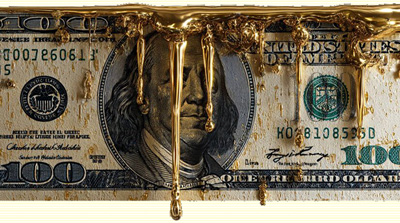 Gold is closing in on $4,700, and even longtime skeptics now admit the real story is currency decay. Meanwhile, mainstream investment house VanEck asks an interesting question: What is gold really worth if money breaks?