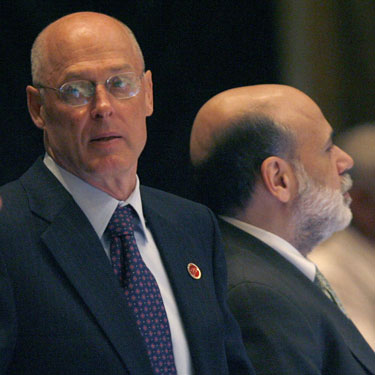
Paulson's Remarks Rattle U.S. Markets (Editor's Note: To see the part about the PMs, you have to read between the lines, - JSB) With the U.S. Treasury Secretary hitting the panic button, can the moment of capitulation for the U.S. stock market be far behind?
Value investors love that moment, because it means that everyone who is going to sell stocks has already done so, leaving loads of money on the sidelines just waiting to pour back into the market. Stock prices have hit a The tricky part is knowing exactly when this moment of capitulation has been reached. There is no ringing bell to announce it. Instead, wily investors must interpret various signs, such as magazine covers announcing the end of equities or retail investors proclaiming they will never own another stock as long as they live. The last moment of capitulation occurred in 2003, when the North American stock market indexes hit their low points following a three-year-long bear market that was inspired by the dot-com implosion. Now, with indexes turning wonky since the end of October, investors are wondering whether there is worse to come or whether stocks are about to rebound with all the bad news already accounted for. It is a tough call to make, but the recent comments from Henry Paulson certainly take the market one step closer to the magic moment. In an interview with the Wall Street Journal, published yesterday, the U.S. Treasury secretary alarmed investors with his comment that home-loan defaults will be "significantly bigger" next year than they were in 2007 -- a shocking observation given how bad this year has been for struggling U.S. homeowners and how serious the downturn has been for consumer spending, economic growth and bank write-downs. "The nature of the problem will be significantly bigger next year because 2006 [mortgages] had lower underwriting standards, no amortization, and no down payments," he told the Journal. He went one step further when he said that he is encouraging the mortgage-service industry to help out groups of borrowers instead of dealing with them on a case-by-case basis. "We're never going to be able to process the number of workouts and modifications that are going to be necessary doing it just sort of one-off. I've talked to enough people now to know that there's no way that's going to work," he said. Predictably, other major indexes around the world also dropped, including the S&P/TSX composite index. It fell 1.3%, bringing its total losses to 9.2%. Meanwhile, the 10-year U.S. Treasury bond soared to fresh two-year highs as investors rushed to safety, sending the yield to about 4%. Of course, there is good reason to heed the warnings of the U.S. Treasury secretary and he should not be seen as a contrary indicator. But given the old saying that stocks look best when there is blood in the streets, Mr. Paulson's observations could very well prove to be an important step on the way to that bloodbath. Now if only Ben Bernanke, chairman of the U.S. Federal Reserve, would break a sweat. Financial Post |
 |
 |