Send this article to a friend:
October
19
2013

|
Send this article to a friend: October |
|
Radioactivity level spikes 6,500 times at Fukushima well
Officials of the Tokyo Electric Power Company (TEPCO) said on
Friday they detected 400,000 becquerels per liter of beta
ray-emitting radioactive substances - including strontium - at
the site, a level 6,500 times higher than readings taken on
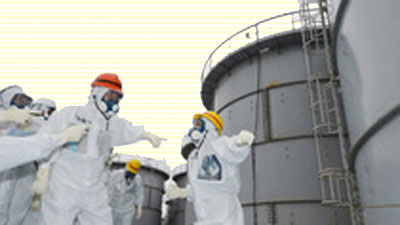
Wednesday, NHK World reported. The storage tank leaked over 300 tons of contaminated water in
August, some of which is believed to have found its way into the
sea through a ditch. The news comes after it has been reported a powerful typhoon which swept through Japan led to highly radioactive water near the crippled nuclear power plant being released into a nearby drainage ditch, increasing the risk of it flowing into the sea. On Wednesday TEPCO said it had detected high levels of radiation in a ditch leading to the Pacific Ocean, and that it suspected heavy rains had lifted contaminated soil. 'Decades-long problems being faced at Fukushima'Robert Jacobs, a professor at Hiroshima Peace University, told RT the compounding problems at Fukushima Daiichi underscore one critical reality: no one really knows what to do.
Experts believe that even a small earthquake could lead to more serious nuclear damage in the area.
Prime Minister Shinzo Abe's open request for advanced knowledge from overseas is a welcome step, as this will bring a higher degree of professionalism than Tepco has demonstrated since the crisis first erupted, Jacobs says. But even though, those experts will be at a loss to solve the immense problems they'll be facing for decades at Fukushima. Even in the one area where Japan could potentially help contain the disaster, the authorities have wavered, Konstantin Simonov from the Moscow-based Fund for Energy Security told RT.
Tokyo Electric Power Company in fact seems reluctant to shut down Fukushima for good. Tepco is in fact pushing to reopen its Kashiwazaki Kariwa facility – the world's largest nuclear power station – which itself was shut down in 2007 following reports of radioactive leaks in the wake of an earthquake. In September, Japan announced its only operating nuclear reactor had been closed for maintenance, leaving the country with no nuclear power supply for only the second time in four decades. Atomic power accounted for 30 percent of Japan's energy needs prior to the Fukushima disaster, and the country was forced to increase fossil fuel imports to make up for the deficit. As a result, Japan become the world's largest importer of liquefied natural gas (LNG), prompting the world's third-largest-economy to post its first trade deficit since the second oil shock 31 years ago. Under these circumstances, the crisis gripping Fukushima will not
be the only factor in deciding the fate of the country's nuclear
industry. |
|---|
Send this article to a friend:
 |
 |
 |