Syria intervention plan fueled by oil interests, not chemical weapon concern, Nafeez Ahmed, Guardian
Massacres of civilians are being exploited for narrow geopolitical competition to control Mideast oil, gas pipelines
... The 2011 uprisings, it would seem - triggered by a confluence of domestic energy shortages and climate-induced droughts which led to massive food price hikes - came at an opportune moment that was quickly exploited. Leaked emails from the private intelligence firm Stratfor including notes from a meeting with Pentagon officials confirmed US-UK training of Syrian opposition forces since 2011 aimed at eliciting "collapse" of Assad's regime "from within."
So what was this unfolding strategy to undermine Syria and Iran all about? According to retired NATO Secretary General Wesley Clark, a memo from the Office of the US Secretary of Defense just a few weeks after 9/11 revealed plans to "attack and destroy the governments in 7 countries in five years", starting with Iraq and moving on to "Syria, Lebanon, Libya, Somalia, Sudan and Iran." In a subsequent interview, Clark argues that this strategy is fundamentally about control of the region's vast oil and gas resources.
Much of the strategy currently at play was candidly described in a 2008 US Army-funded RAND report, Unfolding the Future of the Long War (pdf). The report noted that "the economies of the industrialized states will continue to rely heavily on oil, thus making it a strategically important resource." As most oil will be produced in the Middle East, the US has "motive for maintaining stability in and good relations with Middle Eastern states":
Climate
Your Labor Day Syria Reader, Part 2, William R. Polk, The Atlantic
... Syria has been convulsed by civil war since climate change came to Syria with a vengeance. Drought devastated the country from 2006 to 2011. Rainfall in most of the country fell below eight inches (20 cm) a year, the absolute minimum needed to sustain un-irrigated farming. Desperate for water, farmers began to tap aquifers with tens of thousands of new well. But, as they did, the water table quickly dropped to a level below which their pumps could lift it.
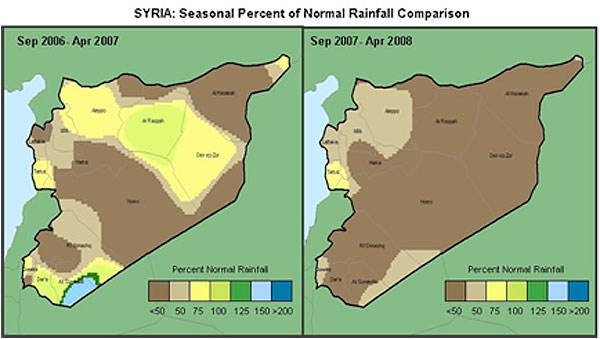
USDA Foreign Agricultural Service, Commodity Intelligence Report, May 9, 2008
In some areas, all agriculture ceased. In others crop failures reached 75%. And generally as much as 85% of livestock died of thirst or hunger. Hundreds of thousands of Syria’s farmers gave up, abandoned their farms and fled to the cities and towns in search of almost non-existent jobs and severely short food supplies. Outside observers including UN experts estimated that between 2 and 3 million of Syria’s 10 million rural inhabitants were reduced to “extreme poverty.”
The domestic Syrian refugees immediately found that they had to compete not only with one another for scarce food, water and jobs, but also with the already existing foreign refugee population. Syria already was a refuge for quarter of a million Palestinians and about a hundred thousand people who had fled the war and occupation of Iraq. Formerly prosperous farmers were lucky to get jobs as hawkers or street sweepers. And in the desperation of the times, hostilities erupted among groups that were competing just to survive.
So tens of thousands of frightened, angry, hungry and impoverished former farmers flooded constituted a “tinder” that was ready to catch fire. The spark was struck on March 15, 2011 when a relatively small group gathered in the town of Daraa to protest against government failure to help them. Instead of meeting with the protestors and at least hearing their complaints, the government cracked down on them as subversives. The Assads, who had ruled the country since 1971, were not known for political openness or popular sensitivity. And their action backfired. Riots broke out all over the country, As they did, the Assads attempted to quell them with military force.
(2 Sep 2013)
An info-rich but readable article at The Atlantic by William Polk, a foreign policy expert and former member of US government. Some conclusions:
- It is not a slam-dunk that the Syrian government is responsible for the poison gas. The investigation is far from complete, and factions among the rebels have motivations for a false-flag operation. But any conclusion is now premature.
- A symbolic action would likely have little effect, and there is significant danger of "mission creep", with the US getting further involved and the conflict expanding.
www.resilience.org