Goldman Adds SMRs to Nuclear Model, Sees 17% Upside in Uranium Demand
Tyler Durden
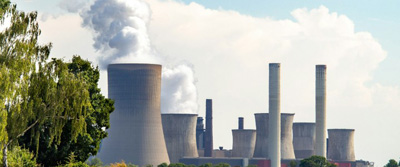 Goldman’s latest edition of Nuclear Nuggets: Global Reactor Tracker reinforces that the buildout of the cleanest and most reliable form of so-called “green” energy, nuclear power, continues to gain momentum. The theme we first laid out in December 2020 continues to broaden, with buildouts accelerating across both large-scale and small modular reactors, even as the growing risk of a massive uranium supply deficit emerges. Goldman’s latest edition of Nuclear Nuggets: Global Reactor Tracker reinforces that the buildout of the cleanest and most reliable form of so-called “green” energy, nuclear power, continues to gain momentum. The theme we first laid out in December 2020 continues to broaden, with buildouts accelerating across both large-scale and small modular reactors, even as the growing risk of a massive uranium supply deficit emerges.
Focusing on the latest North American reactor progress and announcements:
4/16/2026 – Canada – Bruce Power has signed an MoU with SaskPower to share its experience in large-scale nuclear reactors, including project development and long-term operations, as Saskatchewan evaluates large reactor technologies alongside its SMR program. The agreement formalizes information-sharing and aligns provincial and federal nuclear strategies.
4/24/2026 – United States – Duke Energy’s Robinson nuclear power plant has been cleared for extended operation to 80 years, after the U.S. Nuclear Regulatory Commission completed its fastest-ever subsequent license renewal review. The approval allows the 759 MW Robinson Unit 2 in South Carolina to operate until 2050 under new accelerated federal timelines.
4/29/2026 – United States – The U.S. NRC has approved subsequent license renewals for St. Lucie Units 1 and 2, clearing the Florida Power & Light plant to operate for up to 80 years, with Unit 1 licensed to 2056 and Unit 2 to 2063. The decision follows aging-management reviews for the extended operating period and secures the long-term operation of the two pressurized water reactors.
5/5/2026 – United States – Brookfield and The Nuclear Company have formed a JV to manage the potential completion of the two VC Summer AP1000 units in South Carolina, supporting due diligence and execution if the project proceeds, subject to approvals and a final investment decision.
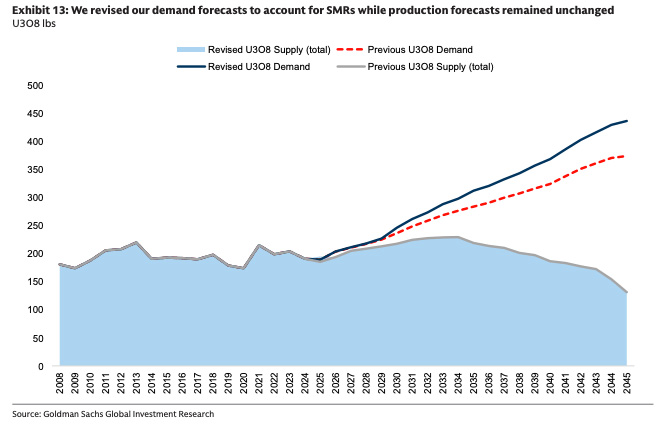
One of the biggest shifts in the note penned by analyst Brian Lee is the addition of small modular reactors to Goldman’s uranium supply-and-demand model, which forecasts cumulative SMR deployments of nearly 46 GW by 2045.
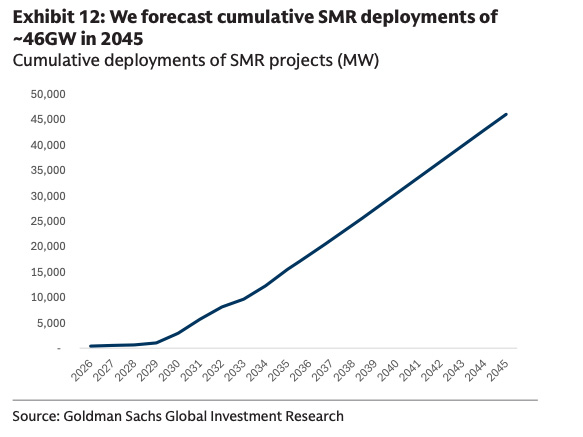
In turn, this would lift its 2045 nuclear generation forecast by about 6% and create an additional 62 million pounds of uranium demand, or a 17% upside to its prior long-term demand estimate.
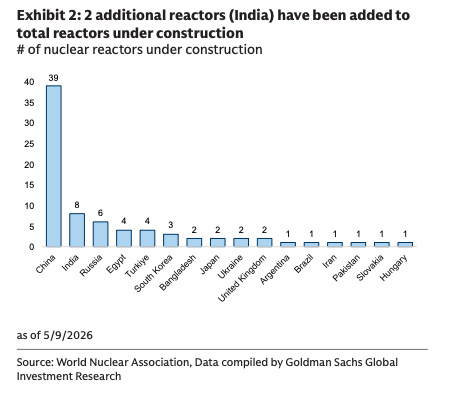
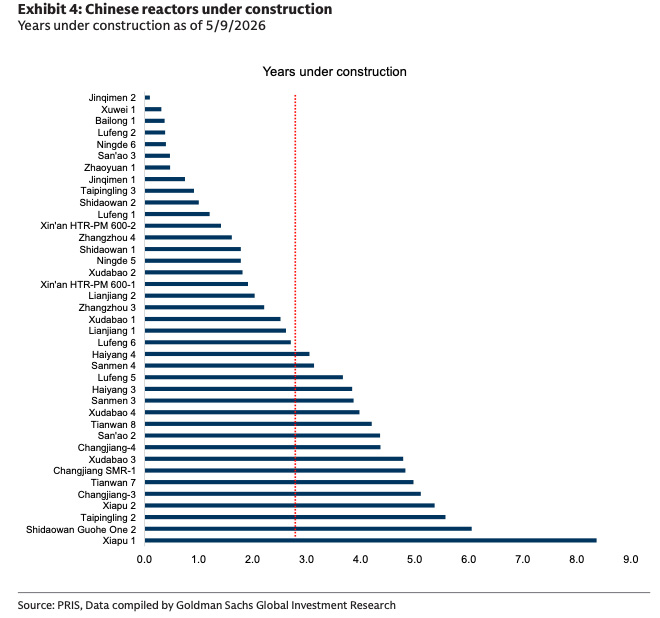
Years under construction, by country:
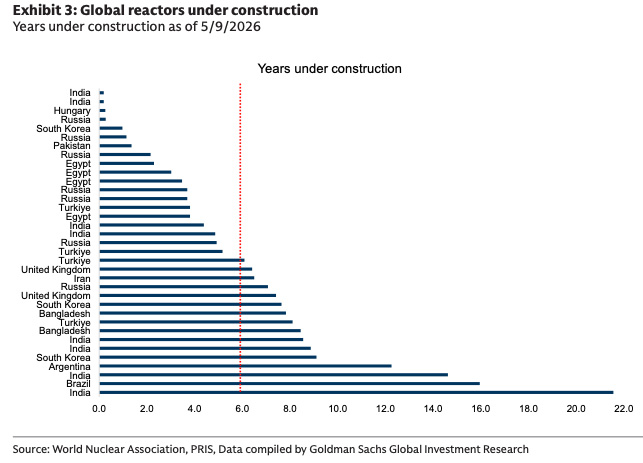
Chinese reactors, years under construction:
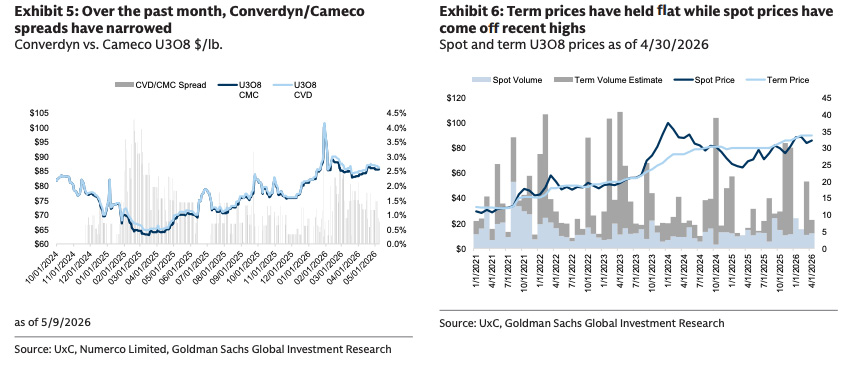
Lee said uranium spot prices stabilized in the mid-to-high $80s per pound after rebounding in April, supported by buying activity in the Sprott Physical Uranium Trust. Term pricing held near $90 per pound, signaling that utilities continue to accept higher long-term pricing deals.
As new reactors come online, Lee warns of a cumulative uranium supply deficit of 2.3 billion pounds between 2025 and 2045.
As new reactors come online, Lee warns of a cumulative uranium supply deficit of 2.3 billion pounds between 2025 and 2045.
Uranium prices will be up and to the right for quite some time...
By Zerohedge
 our mission: our mission:
to widen the scope of financial, economic and political information available to the professional investing public.
to skeptically examine and, where necessary, attack the flaccid institution that financial journalism has become.
to liberate oppressed knowledge.
to provide analysis uninhibited by political constraint.
to facilitate information's unending quest for freedom.
our method: pseudonymous speech...
Anonymity is a shield from the tyranny of the majority. it thus exemplifies the purpose behind the bill of rights, and of the first amendment in particular: to protect unpopular individuals from retaliation-- and their ideas from suppression-- at the hand of an intolerant society.
...responsibly used.
The right to remain anonymous may be abused when it shields fraudulent conduct. but political speech by its nature will sometimes have unpalatable consequences, and, in general, our society accords greater weight to the value of free speech than to the dangers of its misuse.
Though often maligned (typically by those frustrated by an inability to engage in ad hominem attacks) anonymous speech has a long and storied history in the united states. used by the likes of mark twain (aka samuel langhorne clemens) to criticize common ignorance, and perhaps most famously by alexander hamilton, james madison and john jay (aka publius) to write the federalist papers, we think ourselves in good company in using one or another nom de plume. particularly in light of an emerging trend against vocalizing public dissent in the united states, we believe in the critical importance of anonymity and its role in dissident speech. like the economist magazine, we also believe that keeping authorship anonymous moves the focus of discussion to the content of speech and away from the speaker- as it should be. we believe not only that you should be comfortable with anonymous speech in such an environment, but that you should be suspicious of any speech that isn't.
www.zerohedge.com
|