Top Hedge Fund Manager: “15% Gold Is the New Normal”
Peter Reagan
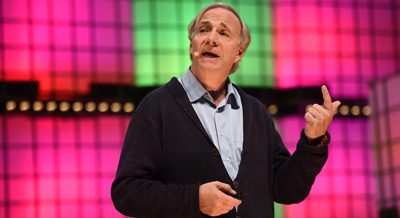
Here's why Ray Dalio is urging investors to up their gold exposure
Before we go into why Bridgewater's Ray Dalio thinks investors should own more gold, let's first talk about how it became normal for investors to own any gold at all.
Of course, gold ownership was always a step that prudent investors considered for themselves. But professional money managers and institutional investors disdained precious metals. For decades, the rule of thumb that dominated investment was limited to two asset classes: Corporate profits and debt. That’s it.
As bizarre as it sounds today, if a mainstream investor did own gold, it was considered an “alternative asset” along with such obscure niche investments as masterwork art, crypto, rare wines or whiskeys and maybe some real estate.
Those days are behind us. During the pandemic lockdowns and the subsequent inflation (and truly bizarre speculative manias involving, among other things, cartoon monkeys), that rule of thumb started to change. For good reasons! Chief among them, U.S. government debt markets experienced the worst year since 1787, according to Bloomberg.1 Those so-called “safe” investments weren’t so safe after all – as first Silicon Valley Bank, then several other banks (and millions of investors) learned first-hand.
That’s about the time that global banks started recommending diversification with gold. The precise percentage varied (5%-15%), but the logic behind it didn’t: Other hedges and “safe haven” assets could no longer be trusted.
Not coincidentally, gold price was leaping from one all-time high to the next. Some 40 price records were set (and broken) in 2024 alone! Central banks set three consecutive gold-buying records during 2022-2024, and global gold demand set a new record in the first quarter of 2026.
Even though the pandemic is well behind us, we’re still living in the aftermath of those difficult years. Today, Dalio thinks a 10% gold allocation is too low and 15% should instead be the goal. That change should make us stop and think – a 50% increase in gold allocation?
Why?
Dalio's reasoning is basically two-fold: Crises and currency.
The first hardly needs explaining, does it? Ever since the lockdowns, there's something terrible happening every year. The “Retailpocalypse” and the collapse of small business. Russia’s invasion of Ukraine, and Biden’s weaponization of the dollar. A container ship blocking the Suez Canal, crippling the global supply chain. The worldwide explosion in sovereign debt (and the subsequent cost-of-living crisis). The second, third and fourth largest bank collapses in U.S. history. The Hamas surprise attack on Israel. Today’s Strait of Hormuz deadlock and the ongoing energy crisis…
Honestly, though, one of the worst blows to the U.S. economy was the 2023-24 interest rate hikes to their highest point in 50 years. Every single analyst worth their salt knew what would inevitably happen… It was like that Slingshot ride at the circus. How do you feel going up? Clammy, anxious and not at all well. And how do you feel when it plummets? Much, much worse.
There was just too much debt – on the federal books and on household balance sheets. We spent nearly two decades functioning in an environment where debt was basically free. Entire industries grew that could only function with infinite free credit. When former Fed Chairman Jerome Powell first started to raise interest rates (with inflation nearing double digits), I argued it was too-little-too-late baby steps. When rates went over 5% for a few months, banks started collapsing and suddenly the federal government’s refinancing costs were $1 trillion a year. Obviously it couldn’t last – and it didn’t. After just 14 months, the Fed reversed course while inflation was still double their 2% target.
Apologies for the history lesson here – but I think it’s very important to remember recent history. All these factors are relevant in Dalio’s argument.
He notes that fewer and fewer global transactions are using the U.S. dollar. Frankly, that’s no surprise. First, there’s the risk of sanctions or weaponization (not that you or I worry about this – but for the rest of the world, it’s a real concern). Second, consider its performance over the last six years. Our dollars have lost at least 22% of their purchasing power since 2020 – I say “at least” because of the missing inflation data from October 2025. Even though it didn’t get counted in the CPI index, it’s still affecting our purchasing power.2 There’s little reason to hold it over the long-term, even where they’re necessary for transactions. Where possible, there is no reason not to choose another, more stable currency.
Even crypto transactions are probably taking away some of the U.S. dollar's luster. (I laughed when I read that the Iranian Revolutionary Guard Council planned to collect a $4 million bitcoin payment from every tanker passing through “their” Strait of Hormuz, but they didn’t mean it as a joke.) International payments with crypto are faster and cheaper than bank wires or electronic payments – and they’re much more difficult to track or sanction.
Dalio’s primary concern for the U.S. economy is stagflation. I genuinely hope he’s wrong. Anyone who lived through our nation’s last bout with stagflation will tell you there’s absolutely nothing to recommend it.
Overall, Dalio is one of the sharpest macroeconomic thinkers you’ll find. That’s why I listen when the man talks. However, there’s one point in particular I believe he got just plain wrong.
He’s telling everyday Americans they need to diversify their savings with 15% gold. That’s a mistake. Here at Birch Gold, we do not make rule-of-thumb recommendations like this. Asset allocation decisions are far too important for your future and must be arrived at on a case-by-case basis. For example, we have some customers with relatively modest savings – for them, preserving what they have is vital. They might have up to a 50% allocation to gold and silver. For our customers who want to balance upside and downside risk, who want a strong hedge against inflation and economic contraction, a 10-15% gold allocation might be suitable.
My point is simply that there’s no one answer that’s correct for everyone.
I think Dalio would agree with me when I say there is, however, one answer that’s wrong for everyone – and that is 0%.
Analysts say Tether's gold purchases are pushing gold price up
Heads are turning as Tether continues to increase its gold stockpile, which capped off March above 132 tons.
Let's go over what that means.
Bloomberg tells us Tether is now the “largest known holder of bullion in the world outside of banks and nation states.”
Tether owns more gold than all but 23 nations. Tether’s gold reserves surpass those of Hungary, South Africa and even Egypt.
Tether has almost three times the reserves of the gold-happy Kyrgyzstan (a big gold-mining nation). Trust me – at $20 billion, this is a lot of gold.
A few things have to be asked here. Is Tether too big to fail?
When you have that much gold, you are greatly insulated from economic distress. Russia's massive gold hoard proved this. Russia was able to ignore the complete severing of its global banking connections, along with dire sanctions (from the U.S. and NATO allies alike). All this while funding an internationally-condemned war effort, almost as if nothing unusual was happening.
This was only possible because it could rely on its gold reserves to prop up its economy. And since the state now officially owns almost all the gold mines in the country (there are lots), those liquidated gold reserves will get replenished easily.
This makes me wonder, why does Tether need a gold reserve? Although they have a digital gold product, their primary business is issuing the #1 U.S. dollar stablecoin. But even the office receptionist there knows the U.S. dollar is nothing to make long bets on. So maybe Tether’s gold reserves exist for the same reason someone like me owns gold – as a hedge against inflation and currency devaluation.
Some claim Tether is a front for hidden interests to buy what look to be hundreds of tons of gold anonymously. Now, there is some weird data corroborating this, like actually downsizing their precious metals division while these purchases are ongoing… I’m not convinced, honestly. I see the rational economic case for owning gold, so the decision to buy gold bullion simply looks wise to me. (Some of my co-workers say I have no imagination.)
On the other hand, Tether might be looking to ramp up its digital gold offering. That seems more logical to me. After all, the massive surge in popularity of digital gold is the result of a massive surge in popularity of physical gold ownership itself. I don’t see it myself – but there really are people who want the financial security of owning gold without the “hassle” of storage and insurance. To each their own.
Greg Shearer, head of precious metals research at JPMorgan, thinks that Tether's gold purchases have played a “material” role in gold prices globally. I’m not convinced – Tether’s seven ton gold purchase in the first quarter of 2026 is huge for a company. But when we consider that total gold demand for the same period was 1,231 tons, Tether’s contribution is just 0.57% of the total. That hardly seems “material” to me. (And yes, the global gold market is huge, the fourth most liquid of all global asset markets.)
It will be very interesting how this unfolds over the coming decade. By their very nature, all cryptocurrencies with the possible exception of bitcoin always run the risk of being completely wiped out. Stablecoins are perhaps even more vulnerable, as losing its dollar peg even briefly can set up a bank run dynamic. Recent history has showed us that the point of no return arrives very, very quickly for cryptocurrencies.
India restricts gold imports, rediscovers the cobra effect
That was fast: Right as I covered India's gold imports hitting an 11-week low, they plunged to a 30-year low just one week later.
Anyone familiar with my exposure on India going back a year knows that this is becoming perhaps the next country to watch in terms of gold developments. China and Russia, yes – they’re major players. But when we take privately-owned gold into account, India collectively has more gold than either of them.
It is my belief that the Indian government, utilizing a network of financial institutions, wishes to eliminate the "consumer" prefix there and effectively nationalize privately-owned gold. It is only a slightly rehashed version of what Russia and China have done, though arguably more insidious.
The second-largest consumer of gold in the world hitting a 30-year low on imports is a story on its own. This happened due to a 3% tariff imposed on gold imports by the Indian government. (Previously, banks were exempt from this.)
Here’s the bigger story from my perspective, though. The Indian government is obviously trying to dissuade gold buyers… So what happened? Right now, investment demand has surpassedjewelry demand in India for the first time ever.
Hence, the “cobra effect.” If you aren’t familiar, it’s an extremely amusing case study in what economists call perverse incentives.
Now, here’s why this matters: For Indians, all gold is investment gold, jewelry, coins or bullion. That's their culture.
Since most of India falls somewhere between low and low-middle class economically, the only ones who can afford “investment bullion” are the affluent minority.
However, it’s India's jewelry hoard among low and low-middle class citizens, particularly in rural areas, that makes it the country with the most gold in the world. Gold jewelry is traditionally gifted to young couples when they get married. That same gold jewelry is passed down within families. It’s considered a personal ornament, of course – but more than that, it’s considered an emergency fund. A source of liquidity only tapped in the worst circumstances – that doesn’t rely on a bank branch being open, or on a credit check to be useful.
Unfortunately, this private gold stockpile is being targeted by an increasingly clever system of cash-for-gold schemes. Sell your gold to the central bank – get cash fast! Yes, the Indian financial sector is basically standing on the corner waving a CASH 4 GOLD sign just when low and low-middle income citizens are struggling more than ever.
So when you're told that Indian investment demand is surpassing jewelry demand, this only means that most Indians can no longer afford to buy gold. And they're being highly incentivized to sell.
The more I watch these developments, the more I am interested, but I don't like what I'm seeing. It’s a cynical ploy for any central bank to offer its own citizens paper currency in exchange for their family heirloom gold jewelry – especially when those citizens are struggling to make ends meet because of the central bank.
Folks, when the government offers to buy your gold, take my advice – bury it in the back yard.

Peter Reagan is a financial market strategist at Birch Gold Group. As the Precious Metal IRA Specialists, Birch Gold helps Americans protect their retirement savings with physical gold and silver.
www.birchgold.com
|