
Send this article to a friend:
May
08
2026
|
Send this article to a friend: May |
The Risk of Hyperinflation
Most of us in the West have become so accustomed to inflation that now it feels natural or normal. The declining purchasing power of a currency is actually deemed to be a good thing, so long as it is ‘orderly’. Most governments plan an orderly decline of 2% per annum in currency purchasing power. Using official government inflation data, and round numbers, we can say that $100, €100, and £100 in January 2000 were actually worth about $52, €58, and £52 in January this year. According to the Big Mac Index (ref. bigmacindex.app), $100 would have bought 44 Big Macs in 2000. Today $100 would buy about 16 Big Macs. Sometimes countries lose control and the gradual decline in purchasing power turns into a rout. In hyperinflationary cases losses of over 99% are common. Although hyperinflation can appear to be quite common, it tends to be somewhat localised or interconnected. For example, Central and South America have endured a series of hyperinflationary events. Additionally, 15 countries that were formerly aligned with former Soviet Union had currency collapses, including much of Eastern Europe and Central Asia. The peoples of Africa have suffered their share of hyperinflationary tragedies. A Creature of Government Fiat currency has a symbiotic relationship with its government. When a country’s political or economic system collapses, its fiat currency collapses with it. It can be a chicken and egg argument as to which comes first country collapse or currency collapse? But either way, hyperinflation is always and everywhere a creature of government. After all, they are the ones printing or regulating the currency via credit market rules and regulations. If you live in a well-run country and have a tradition of stable government you have reasons to be optimistic. For example, there is no recorded history of hyperinflation in Britain. This is quite remarkable considering most countries have lived through crashing currency values at some point in their history. Unfortunately, Britain is an exceptional case, but that may not be for much longer. A good way to assess whether you will be a victim of hyperinflation is to pose one simple question: what will my country do if there is a severe financial or economic crisis? Will it do the right thing or the wrong thing? The post-World War I fates of Britain and Germany give a pretty good example of how to do the right thing (in Britain’s case), or choose the wrong path, as in Germany’s case. Weimar Germany 1919-1923 After the war Germany remained mostly intact. Mercifully aircraft technology was quite new and the country was spared aerial bombardments. Its roads, factories and general infrastructure were still in place. The war and the Versailles Treaty that ending it, bankrupted Germany. Finding a way out was always going to be difficult. Amidst scenes of chaos and absurdity Germany transitioned from a monarchy with limited democracy to a total democracy in November 1918. Universal suffrage was declared for the first election of the new republic in January 1919. This helped to triple the votes cast compared to the previous elections (1912). It also raised expectations, which were soon to be crushed. Germany, like Britain, had broken from the gold standard at the outbreak of the war in 1914. Reichsmark banknotes were no longer convertible to gold or silver. The Reichsmark became the Papiermark. The fledgling republic found itself immediately wedged between mounting debts relating to the war including those from the subsequent Treaty of Versailles and the expectations of its citizens of the new republic. They were unable (or some may argue unwilling) to reinstate the previous gold standard. Money printing became standard practice and what followed was a tragedy. Photos of the Weimar hyperinflationary collapse often show semi-comical images of wheelbarrows stacked with banknotes, etc. 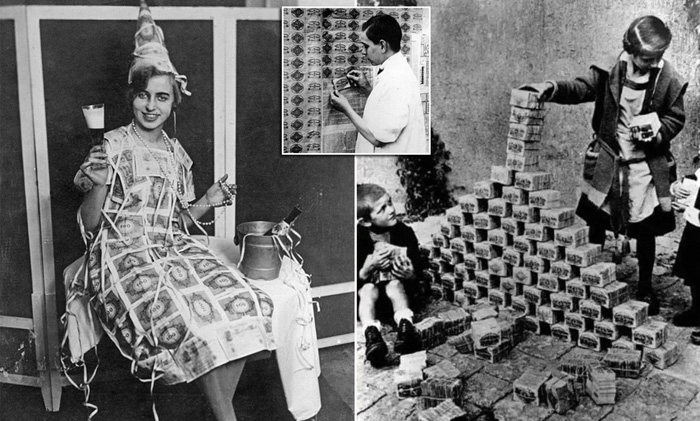 No laughing matter But the reality of daily life for most people and especially the middle class was horrific. Those with previously comfortable lives saw their savings and pensions decimated. Monthly pension payments were not worth the price of a single apple. Savings and investments in government bonds were literally rendered worthless. 100 Reichsmarks of savings in 1913 were worth 0.00000000001 Reichsmark in 1923. Expensive furniture, family heirlooms and jewellery were sold for groceries. Society broke down. Street prostitution, corruption, crime, and malnutrition were everywhere to see. Old people unable to live off their savings or pension faded away in their homes. Britain 1919-1923 Similar to Germany, Britain emerged from the war mostly intact. Like Germany it had financed the war via government debt. £100 of savings in 1913 were worth about £50 in 1923. This obviously is a very different outcome compared to Germany. Perhaps even more interestingly this £50 of purchasing power was markedly higher than it was in 1920 (£35). In other words, British inflation peaked in 1920 and was followed immediately by a period of deflation. Britain not only avoided a hyperinflationary collapse, but it actually reversed course to deflation. The question is, how? Similar to Germany, the British political system evolved from a limited democracy where only 60% of men could vote to a more universal system in 1918. However, unlike Germany this change was more orderly. The general election of December 1918 delivered a political leadership similar to what had gone before. Traditional ideas of sound money dominated political discourse. Interest rates rose to around 7% by 1920, which in turn reduced borrowing and caused prices to drop. This medicine caused the economy to contract and drove unemployment to almost 20%. The hard road the ruling elite in London chose did cause much pain to the lower and working classes resulting in the first formation of a Labour government in January 1924. The stresses and strains imposed upon post-war Britain and Germany were different. But it is useful for comparison terms that their challenges shared the same provenance – 4 years of mutual destruction in World War I. Why they chose different paths is not pertinent to this commentary, what matters is what they did. Don’t get caught up in the causes of the crisis. Focus on the reaction functions of the British and German political leadership. What matters to us today is what will our leaders do in the event of another geopolitical or financial calamity? A crisis is only a catalyst and it could be anything. It could be an energy crisis, a war or a global financial crash. It does not matter. What matters are the instincts and political reactions of our leadership. The motivations of our leaderships are not important, or whether they be judged as honourable or not. In my synopsis of the German and British political reactions to post-WW1 inflation I gave scant regard to their motivations. In my view wealthy Western democracies will be inclined towards hyperinflation. Many of them, including Britain, have little or no experience of hyperinflation. Their political leadership is very responsive to the short-term will of their electorates insofar as political cycles can turn quicker than economic cycles. The two characters in the picture below made the correct decisions for Britain after WWI. Lloyd George (Liberal Party) presided over the move to deflate the economy in 1920 and Winston Churchill (Conservative Party) followed up by moving Britain back onto the gold standard in 1925. 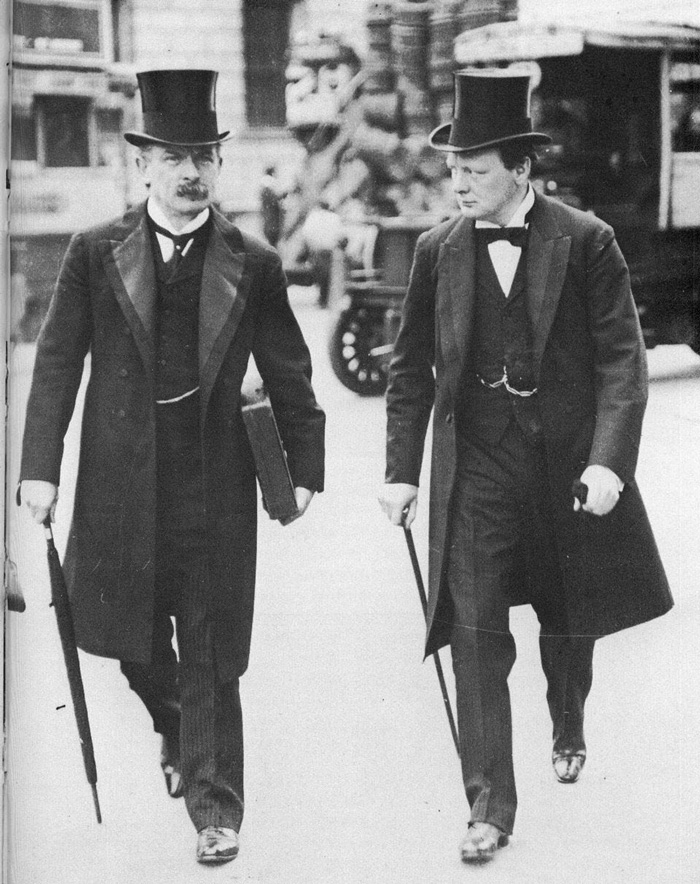
Modern Government Traditional doctrines of sound money are almost unheard of in modern Western political discourse, or anywhere else for that matter. In the event of another economic crisis, irrespective of its cause, I believe any suggestion to raise interest rates and curtail lending in order to save the purchasing value of the currency would not be taken seriously at all. Any suggestion to move to a sound money system (Gold) would be ridiculed. In the 2020 Covid Hysteria crisis, the UK M2 supply increased by about 25% in 2 years. The numbers for the Eurozone are about the same. Not to be outdone, the United States increased money supply by 50% in two years. The only offset to all of this money printing is the ability of the private sector to produce more goods and services at greater efficiencies and thus lower costs. Conclusion Printing money has worked beautifully from a political perspective in rich Western countries. It would be political suicide to do what the British did in 1920 or 1925. Many will argue that central banks act independently of politics, and the example of Paul Volcker, the US chairman of the Federal Reserve (1979-1987), bolsters this argument. Mr. Volcker’s Federal Board famously raised interest rates to as high as 20% in order to curb high inflation and presumably avoid a dollar collapse and hyperinflation. Indeed, today most central banks are, nominally at least, politically independent. I take the argument that central banks could raise interest rates seriously, but I disagree. In my view central bankers are subject to the same political vicissitudes as their political masters in government. Furthermore, even if deemed necessary, I don’t think it is politically possible to increase interest rates to double digits. Modern Western electorates are accustomed to their governments providing palliatives to mollify the pain of severe economic contractions. If I am correct and we are politically unable to tighten fiscal and monetary conditions to ward off hyperinflation, then it appears as though risks of hyperinflation are elevated. Thanks for reading! Subscribe for free to receive new posts and support my work.
The Great O’Neill pursues profits from upward AND downward price movements in stocks, bonds, currencies and commodities.
|
Send this article to a friend: