Send this article to a friend:
May
13
2026
|
Send this article to a friend: May |
Will America Be Expelled from the Middle East?
Last week began with the provocative actions, boastful claims, and sharp reversals for which President Donald Trump has become notorious since the beginning of his ill-fated Iran War. On Sunday, Trump announced that on Monday morning he would launch “Project Freedom” using the American navy to escort out commercial vessels that had been trapped by the Iranian blockade of the Strait of Hormuz. But when the Pentagon impressed upon him that his warships would probably be sunk, he quickly reversed himself, saying that American forces would merely “guide” those trapped ships to safety, without specifying exactly what that term meant. By Tuesday, he had further reversed himself and announced that he had “paused” the operation, thereby greatly embarrassing Secretary of State Marco Rubio, who just hours earlier had declared that the effort was America’s top priority. It soon came out that the Saudis and Kuwaitis had been blindsided by the American plan and they refused to allow their bases or airspace to be used, fearful that the result might lead to a dangerous military reescalation of the conflict with Iran. On the Truth Social website, Trump justified his sudden policy reversal by the face-saving excuse that “great progress” had been made towards a “complete and final agreement” with Iran, presumably on terms that he would find quite congenial. Trump had said much the same thing on at least eight or ten previous occasions, so I paid no attention to his offhand remarks. These struck me as further confirmation of the negative appraisal of his mental balance that I’d published just a day or two earlier. But the influential Axios media outlet soon substantiated Trump’s casual words in an article by Barak Ravid, its chief Middle East writer. This exclusive declared that:
So a peace agreement—including a reopening of the Strait of Hormuz—was allegedly now close at hand, and the Axios report was very widely quoted all across the mainstream media. Despite the strong response of that echo chamber, I hardly took the story seriously. Over the last couple of months I’d gradually concluded that Axios and Ravid were far from reliable sources, often passing along the sort of misinformation promoted by our own government or that of Israeli Prime Minister Benjamin Netanyahu. Indeed, soon after this latest story ran, famed journalist Glenn Greenwald ridiculed the piece while describing Ravid’s extremely suspicious professional background.
Some of the particular details of Ravid’s latest story seemed especially fishy to me. The supposed agreement in question was merely a one-page memorandum and there had certainly been no face-to-face negotiations between American and Iranian representatives. I found it extraordinarily implausible that the Iranians would consider relaxing their stranglehold over the windpipe of the world economy because Trump or his aides had sent them a one-page proposal unless it represented an offer of total American surrender, and even then they would never have trusted our mercurial president. While Trump may well have lost his mind, I doubted that the same was true of the Iranians. Col. Daniel Davis was equally dismissive, explaining his extreme skepticism in a short video discussion. A few hours later, he also ridiculed Trump’s subsequent claim that Iran had lost the war and was about to submit: Just a week earlier, Davis had interviewed Prof. John Mearsheimer, and the very distinguished academic had provided an entirely contrary appraisal, declaring that America had lost the Iran War, with that segment viewed hundreds of thousands of times. Ironically enough, Mearsheimer’s verdict on the conflict has now been fully seconded by Robert Kagan, for decades one of our most committed Neocon pro-Israel interventionists:
Indeed, not long after that Axios story ran, top Iranian leaders denied almost all of its particulars. They certainly weren’t talking with the Americans, they hadn’t changed any of their demands, and they hadn’t yet even bothered responding to the peace proposal that the Americans had asked the Pakistanis to pass along to them. The Speaker of the Iranian Parliament even ridiculed the media outlet that had broken the story as the notoriously unreliable “Fauxios.”
And by the end of the week it became totally apparent who had been telling the truth regarding the alleged state of negotiations:
So based upon all these considerations, I regarded Trump’s statement and the Axios story as totally inconsequential, just more of the same dishonest and boastful Trumpian blather that I’d been seeing since the first days of the war. But to my total astonishment, others reacted in very different fashion, and this was especially true of the financial markets. As the New York Times reported, oil price futures dropped and stocks shot upward to new record highs.  
In a highly suspicious development, hundreds of millions of dollars were made in crude oil shorts that had been bought just prior to the release of the Axios report.
According to the Daily Beast, this was merely the latest example of such massive profit taking due to possible advance knowledge of Trump’s announcements of dubious peace proposals:
As Kevin Barrett noted, these suspected insider trades took place on March 23, April 7, April 16, April 21, and then again last Wednesday, May 6. Although the Iranians soon explained that they weren’t actively negotiating with the Americans and they ridiculed the media reports that a peace agreement might be imminent, oil prices still sharply fell and stayed down, which seemed totally irrational. After so many false reports of a peace agreement being almost at hand and the strait about to be reopened, I found it difficult to believe that even the most gullibly optimistic trader would accept these statements at face value, let alone that there were enough of those traders to move the markets in such dramatic fashion. But perhaps the solution to this mystery was that these major market movements were actually due to trading by AI systems, which made their decisions mostly based upon how they expected all the other AI trading systems would react to Trump’s statements. A shrewd observer had suggested this possibility last month:
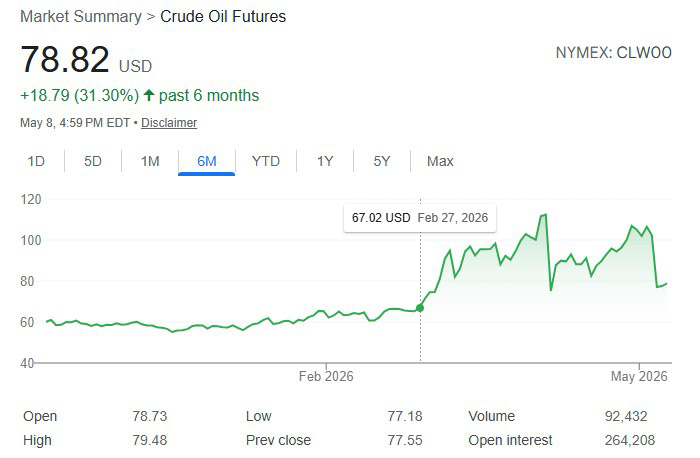
There are a wide variety of different categories of oil prices, something that greatly adds to the confusion. But if you Google “Oil Prices” a simple chart comes up showing that oil price futures had collapsed by more than 20% in just a 24 hour period and never recovered.
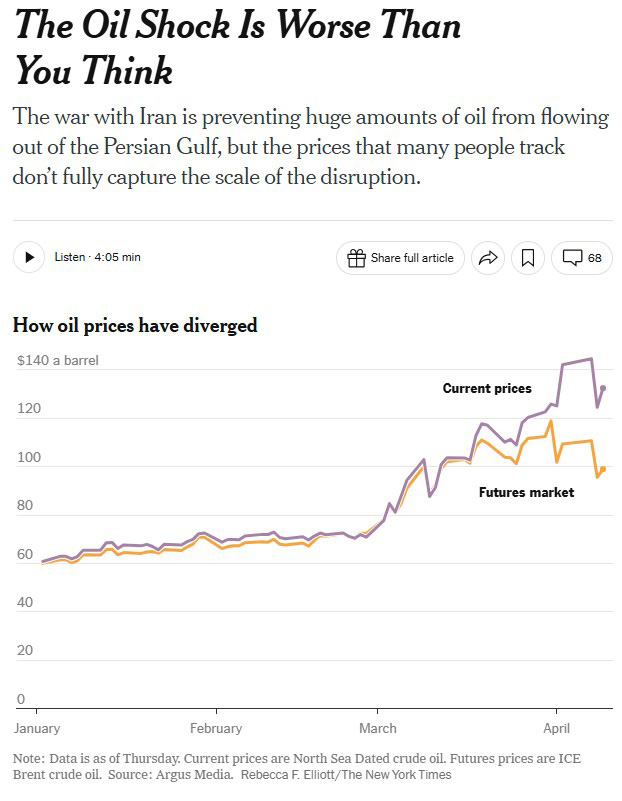
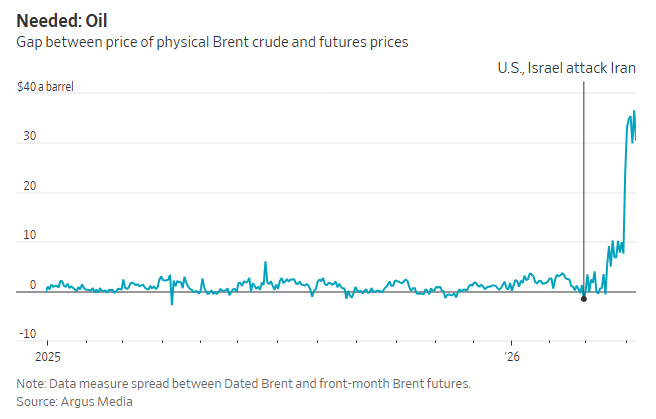
So these oil prices were now back down to what they had been in early March more than two months ago at a time when everyone expected the Iran War to be over within another few days. Indeed, today’s figure was only about 18% higher than the price on February 27th just before the conflict even began. The website OilPrice.com provides a very wide range of different oil price charts, and last week’s meaningless news story caused July Brent Crude futures to drop from over $114 to $101. That latter figure does represent an increase of nearly 40% from the pre-war $73, but still nothing remotely like the huge spikes that had originally been so widely expected. This sharp drop to very moderate oil pricing levels made absolutely no sense to me. Two months ago after the Iranians had successfully closed the Strait of Hormuz to most oil shipments, the desperate American government had lifted all sanctions from Russian crude, thereby making available up to 200 million barrels of already exported but unsold oil. We had then even done the same to Iranian oil, willing to inject a huge amount of new government revenue into the coffers of the country we were trying to destroy. This added at least 140 million unsold barrels to world oil markets, with University of Tehran Prof. Mohammed Marandi later claiming that the true figure was closer to 200 million barrels. Meanwhile, Western governments also agreed to release 400 million barrels from their strategic petroleum reserves. The loss of Persian Gulf oil was estimated to have totaled around 500 million barrels by mid-April. But with up to 800 million additional barrels suddenly made available to world markets, any initial impact from that loss had been completely mitigated, with the early price rises only due to panic buying, hoarding, and gouging, as well as some regional misallocations. However, the conflict had now lasted more than ten weeks, so those early sources of additional supply would have mostly been exhausted by now and we should be seeing the huge resulting projected price hikes in oil futures. Yet the exact opposite had actually occurred. Last month I had noted this very strange situation, citing articles in both the New York Times and the Wall Street Journal, each of which quoted oil experts who were just as puzzled as I had been by the disconnect between physical and paper oil prices. As the Times wrote:
The Journal told the same story of the massive, strange gap that had suddenly appeared between oil futures and physical oil prices:
When I’d published that article, my analysis drew a fierce rebuttal by a zealous market-fundamentalist calling himself “Arete.” He produced an astonishing 20,000 words of rather ideological remarks arguing that market prices were invariably accurate and realistic and if they declared that within a month or two oil would be much cheaper than today that obviously represented the best-informed weighted average result of future geopolitical scenarios. But an additional month has now gone by, and the Persian Gulf waterway remains stubbornly closed. Trump has even declared his own counter-blockade of Iranian ports, aimed at removing Iran’s own large oil shipments from the international market. Yet oil future prices have actually dropped, an utterly bizarre development that raises all sorts of troubling questions. The most obvious of these is whether these public oil prices actually reflect reality, and in a very telling statement last month, the Saudi Finance Minister declared that they did not:
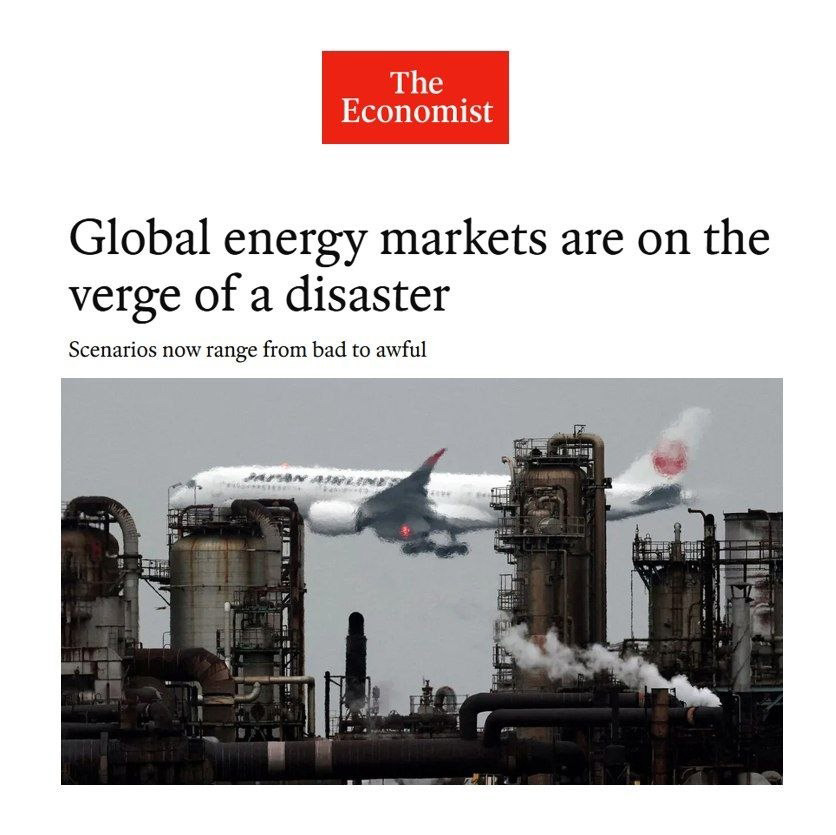
A few days ago, a Middle East expert was interviewed on Bloomberg and said much the same thing, warning that the world economy was headed towards a cliff. He explained that although oil prices were listed at $110 per barrel on market terminals, nobody could actually buy oil at that price, with physical barrels already selling at $150 or $170. Bloomberg is one of the biggest business channels, probably watched by large numbers of the global oil brokers who know the reality of those physical prices. So if Bloomberg and the guests it promoted were talking total nonsense about something as extremely important as world oil prices, surely someone would have gotten fired. I think that this whole strange situation may recall the notorious pricing problems that helped doom the old USSR. As a purported workers’ state, Soviet shops always priced their meat, fruit, and other desirable foods at the low levels favored by their customers. But none of these important goods were actually available for purchase at those prices, instead always being “sold out the back door” or found on the black market at huge markups. So if the vital, Western-dominated oil markets have now lapsed into echoing the manipulated pricing systems of the old Soviet Union, perhaps our political and economic system will soon follow a similar trajectory into the trash-can of history. Founded in 1843, the Economist is the world’s oldest newsweekly and certainly the most influential, perhaps even ranking first among equals compared with the other Western publications at the pinnacle of mainstream journalism such as the Wall Street Journal, the Financial Times, and the New York Times. From that lofty perch, the Economist editors feel comfortable issuing the sort of bold pronouncements that their lesser counterparts might timorously avoid. I doubt that any other publication can match the length and depth of their support for markets, but such support must always be tempered with realism. So over the last few weeks their pages have regularly resounded with warnings of the dire economic calamity the world was facing from the loss of Persian Gulf resources due to the Iran War, while sharply criticizing the financial markets for failing to recognize that looming reality. As I cited in my previous article:
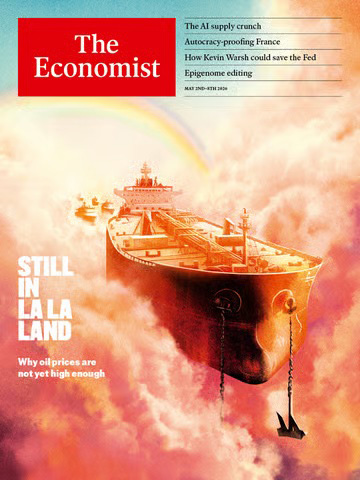
Last week’s edition was even more scathing. The Economist cover condemned the financial markets as “Still in La La Land,” with their editorial describing the situation:
The longer briefing article in the same issue was entitled “The Crisis in Oil Markets Will Get Bigger Before It Goes Away”, summarized by the heading “Nothing in the Tank”:
Over the last few weeks numerous other observers have fleshed out some of the massive supply shocks that the world may soon begin to experience. For example, according to an OECD report global commercial crude inventories are already approaching their lowest levels in twenty years, with nothing to prevent them from dropping far below that previous floor, which had been considered their minimum operational level.
This same supply chart was discussed in much greater detail in a lengthy YouTube interview with Chris Martenson, a seemingly knowledgeable commodities analyst, who also summarized his conclusions in a much briefer clip distributed on Twitter.
A few days ago, Bloomberg interviewed Jeff Currie, a senior advisor to the Carlyle Group. He said he had “never seen anything like it before” and gave his various estimated dates at which the available storage supplies for oil, jet fuel, diesel, and gasoline would reach “tank bottom” in Europe and in the United States. He even analogized the insouciance of the financial markets and the media to the scene in the film Jaws in which the local mayor declared the beaches open for swimming even as the director showed a very ominous shark fin slicing through the water.
Others distributed projections of oil inventories produced by the research analysts at JP Morgan, and estimates of the possible resulting gasoline prices.
Around one-third of the world’s fertilizer also comes from the Persian Gulf and the loss of that supply over the last couple of months has greatly inflated prices, making it difficult for farmers around the world to purchase the necessary quantities. This certainly includes America, with 78% of Southern farmers unable to afford their regular amounts of fertilizer.
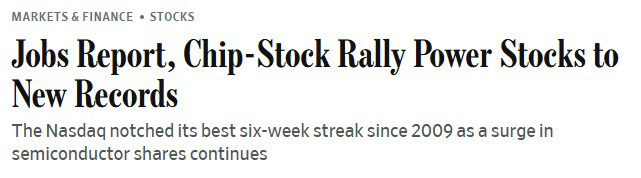
Given all these negative developments, it’s hardly surprising that a few days ago the WSJ reported that American consumer sentiment fell to new record lows in May. But a couple of days earlier, the same newspaper also reported that consumer spending still remained very robust. I suspect that the reason for this seeming paradox is that the former is reported on a population basis while the latter is given in aggregate dollars. So the wealth effect of a record-setting stock market may have encouraged the more affluent slice of our population to spend very freely, thereby masking the impact of the growing debt, impoverishment, and cutbacks of the much larger majority. Indeed, this enormous rally in stock prices continued on Friday, with the S&P 500 and Nasdaq both setting new record highs.
But much of that continuing boom has been driven by AI, with AI investment accounting for roughly half of overall GDP growth last quarter. Many strongly suspect that we are approaching the final, manic stage of an AI Bubble, probably the largest financial bubble in world history. Of these critics, the most trenchant has probably been an independent analyst named Ed Zitron, who has been arguing for the last year or so on his Substack that the financial structure of the entire AI sector is merely a fragile house of cards, likely to soon collapse and take down some enormous corporations with it. In his latest lengthy posting, written in his characteristically pungent style, Zitron argued that the AI industry shared some characteristics with a Ponzi scheme, claiming that large new injections of investment venture capital are effectively being converted into the circular revenue streams that have so impressed many of those supplying that funding. Although I’ve made no effort to investigate these issues in detail, I found many elements of his analysis quite persuasive. The extreme fragility of American financial markets may also explain a strange development three weeks ago as Treasury Secretary Scott Bessent endorsed the request of the United Arab Emirates that it be granted a dollar swap line of credit. Although the Iranian blockade of the strait had cost the Emiratis much of their regular oil revenue, they were fantastically wealthy, having a combined sovereign wealth fund totaling some $2.7 trillion, so they would hardly seem in need of any American financial assistance. But the obvious problem was that most of that accumulated UAE wealth was probably invested in American Treasuries, stocks, or private equity funds. Bessent clearly feared that if any significant portion of those assets were suddenly liquidated, this might trigger a dangerous financial avalanche, and he said as much in a public Senate hearing:
The Speaker of the Iranian Parliament noted the financial discomfort of his American foes on Twitter.
The dollar financial credit line that America extended may have quietly included a particular quid pro quo. Just a few days later the UAE announced that it was leaving the OPEC oil cartel that it had joined more than a half-century earlier. In recent years the Emiratis had had increasing conflicts with the Saudis over various political and economic issues, and in the current Iran War, they came down very forcefully on the American and Israeli side. A couple of days before their OPEC departure, the media reported that the UAE had received an Iron Dome missile defense system from Israel, along with the Israeli troops to man it, and the Iranians reacted with great hostility to these developments. The UAE port of Fujairah had allowed them to partially circumvent the Iranian blockade imposed on the Strait of Hormuz. But a few days ago the Iranians published a map extending their Persian Gulf zone of control to that area, then underscored that control with missile and drone strikes that damaged some of the local facilities. Meanwhile, other Gulf Arab countries may be moving in a very different political direction. Last week’s unexpected refusal by the Saudis and Kuwaitis to allow America to use their bases or airspace for “Project Freedom” may be an early indication of this, a consequence of America’s looming strategic defeat in its war against Iran. Over the last decade, we had spent well over two trillion dollars on our naval forces. One of our navy’s most crucial missions had been safeguarding the vital sea lanes of the Persian Gulf, but that mission has obviously been a complete and total failure. Our annual military spending has been comparable to that of the rest of the world combined and more than one hundred times greater than Iran’s. But despite our surprise attack, we had failed to defeat the Islamic Republic, or successfully protect our Gulf Arab allies from suffering Iran’s retaliatory responses. Although Trump and other American officials had repeatedly boasted that their airstrikes had destroyed the overwhelming majority of Iran’s missiles and launchers, a few days ago the Washington Post revealed that a confidential CIA analysis had reached very different conclusions:
Meanwhile, we had spent years or even decades accumulating our enormously expensive arsenal of advanced “boutique” weapons, but we have now expended a considerable fraction of those munitions during just a few weeks of full combat against Iran. According to a CSIS report, in many key categories we had exhausted at least one-third to one-half of our entire global stockpiles. 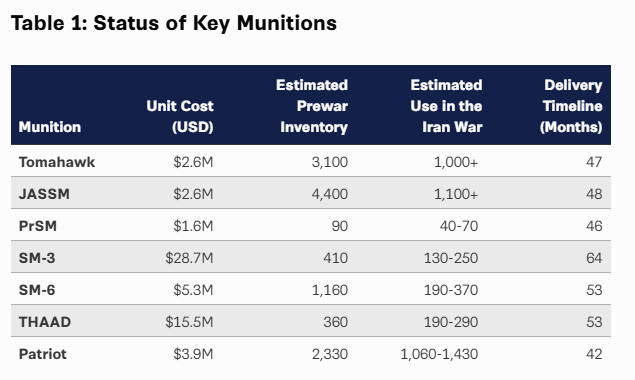
Furthermore, our Gulf Arab allies have now realized to their great dismay that instead of representing sources of protection, our numerous regional military bases had merely drawn Iranian attacks. Recent assessments also revealed that those bases had been heavily damaged, with our air defense systems proving entirely ineffective against Iranian missiles and drones. The MoA blogger highlighted a very telling article by a Wall Street Journal reporter based in the UAE:
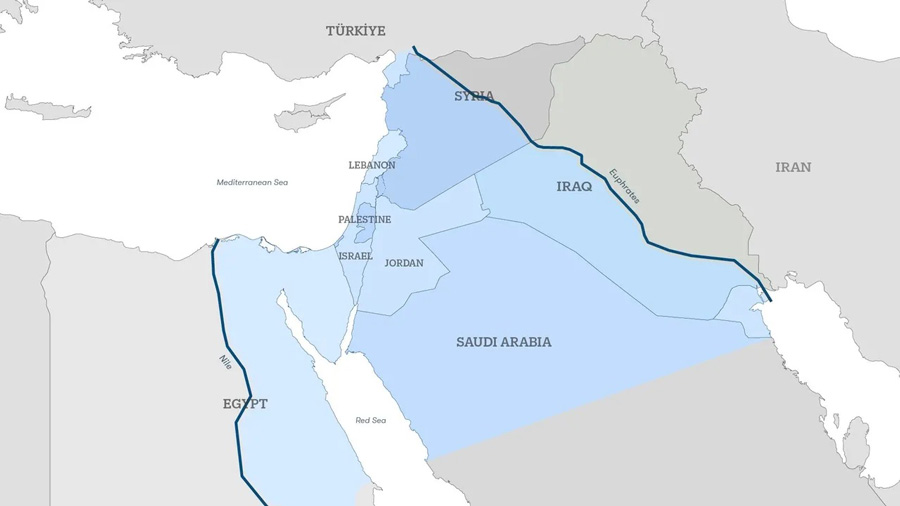
As I discussed in a February article, just a few days before the start of the Iran War, Tucker Carlson had released a long interview with Mike Huckabee, the American ambassador to Israel. In their discussion, Huckabee declared himself a firm believer in Israel’s Biblical rights to most of the entire region, regardless of which other countries currently controlled those territories. This divinely mandated Greater Israel not only included the West Bank and Gaza but also all of Jordan and Lebanon, most of Syria, and very large portions of Iraq, Saudi Arabia, and Egypt. Thus, Israel’s true borders encompassed nearly all of the Middle East, and increasing numbers of Israelis have declared their determination to implement that project.
When Carlson pressed Huckabee in their conversation, the latter expressed his support for such Israeli territorial expansion, declaring “It would be fine it they took it all.”
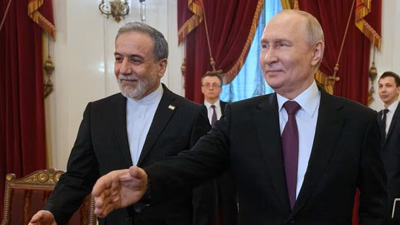
Despite the resulting firestorm of angry protest, Huckabee kept his job and was never disciplined for his shocking remarks, suggesting the strength of the American political constituency that endorsed them. This surely would have made the Saudis give much greater consideration to other possible security arrangements. Over the last two weeks, Iranian Foreign Minister Abbas Araghchi traveled to a number of countries, holding important talks with the Russians and the Chinese among many others. A couple of days ago, former CIA Analyst Larry Johnson published a very interesting and provocative post entitled “Russia and China are Serious About Replacing the US as the Persian Gulf Power Brokers.” He noted that during their meetings with Araghchi and also afterward, Russian President Vladimir Putin, Chinese Foreign Minister Wang Yi, and various other senior officials from those countries had repeatedly used the term “Security architecture” to describe what they deemed necessary to restore peace and stability to the vital Persian Gulf region. Both Russia and China condemned the US-Israel war against Iran and expressed support for many of Iran’s stated goals. These notably included the complete removal of all US military bases from the region and full recognition of Iran as a legitimate regional power, eliminating all the many Western sanctions imposed against it for decades. Most remarkably, Johnson closed his brief discussion by passing along word of a potentially dramatic development:
Just over two years ago I published an article focusing upon the relations between America, Russia, China, and other major world powers. In that context, I had discussed the books and geopolitical theories of former National Security Advisor Zbigniew Brzezinski, one of our most renowned geopolitical strategists. In his 1997 book The Grand Chessboard, he had noted the tremendous power and the important advantages that America possessed. But he also emphasized that our country would need to use that power wisely lest we provoke the creation of an opposing global coalition:
After quoting those remarkable insights from nearly thirty years ago, I wrote:
I recently came across a YouTube compilation of Brzezinski’s Charlie Rose interviews on PBS. They provide excellent examples of his geopolitical wisdom and sophistication, characteristics so sorely lacking in recent American administrations. I would highly recommend that people watch it.
|
Send this article to a friend: