|
|
Mainstream Media Critical of the Fed?
Dominant Social Theme: From Fed incompetence to monetary Nirvana. Free-Market Analysis: Over the weekend, we analyzed a Washington Post article describing the economic crisis in simple but powerful terms. The article maintained that the problem was caused by risky lending and the solution was regulation to impel "banks" to reduce practices that could lead to risky lending. We pointed out in our analysis that regulatory efforts will likely fail - as they always have in these situations (and in fact all such situations) - and that it would be much better to let the free market work. We also pointed out that it was not possible to let the free-market work because the Federal Reserve was responsible for the monetary euphoria that caused the risky lending - and the Fed is a money-fixing operation itself. Thus the root cause of the problem was not risky lending but the over-production of money that led to the risky lending. The solution would not be regulation, therefore, but reducing or eliminating the power of the Fed to print money, causing booms and then terrible busts. Now comes a Washington Post article - a virtual follow to the previous piece (and both editorials) - that tackles the very issue that we just analyzed in the previous Post article. This article, excerpted above, goes beyond the puerile analysis of "risky lending" to identify a key source of the problem as Fed bankers' lack of ability or will-power to raise interest rates and otherwise to control the loose monetary policy that led to mortgage euphoria and thus the economic crash that has (to a degree, at least) destroyed the modern fiat money system. Here's some more from the article:
This article is fascinating to us because it rehearses significant evidence of the conundrum that is the Federal Reserve (and central banking, generally). In the past we have referred to a series of astonishing mainstream editorials that Alan Greenspan wrote in the early 1990s virtually admitting that the Fed had no way of adjusting monetary policy (other than guesswork) because there were no forward-looking trustworthy indicators of where the economy was heading. He included gold in this confession, by the way. Nothing was forward-looking, he proclaimed. The Fed was basically driving the world's most famous and powerful monetary hyper-car down a dark, winding road at high speeds without headlights. He seemed to imply that a grievous crash was inevitable. And he was right. Now comes the author of this article, Roger Lowenstein to condense and present, in a most concise fashion, the damning evidence of central bank dysfunction. And who is Lowenstein? According to Wikipedia, he is an, "American financial journalist who reported for the Wall Street Journal for more than a decade, including two years writing its 'Heard on the Street' column, 1989 to 1991. Before becoming a full time journalist, Lowenstein was an attorney with various New Jersey law firms. Lowenstein has published three books and co-authored one. In addition, he has written for many publications, including Smart Money and The New York Times. ... He is also a director of Sequoia Fund. His father, Louis Lowenstein, was an attorney and Columbia University law professor who wrote books and articles critical of the American financial industry." Lowenstein also wrote a popular book called "The End of Wall Street" - so he might be considered a skeptic of the modern financial system (and apparently it runs in the family). But before we get too carried away with the skepticism that Lowenstein has evinced in this article, we need to examine its conclusion, as follows: "We know from bitter experience that markets do err and that the errors are often detectable in real time. There was no shortage of critics who warned of a housing collapse. Moreover, the Fed does not require perfect knowledge when it raises rates to ward off inflation; it relies on a best-effort prediction that the risk of inflation is serious. It can and should act in the same way - adjusting interest rates upward - when it fears unwarranted inflation in investment assets." To put it bluntly, this is the type of conclusion that makes us tear out our collective hair. Lowenstein spends a good deal of time and effort composing an article that analyzes the inability of the Fed to determine market bubbles (and both of the chairmen he mentions have actually indicated that the Fed has no forward-looking methodology to do this) and then suggests that the Fed move aggressively to control market bubbles. How does that make sense? It doesn't. In fact, this sort of article contributes to what we would call a power-elite Hegelian dialectic. We've mentioned this many times in the past, and let us hasten to add that we are not necessarily accusing Lowenstein himself of being part of any propagandistic exercise. But it is our job here at the Daily Bell to analyze dominant social themes, and one of the tools used to implement these promotions is undoubtedly the Hegelian dialectic. We have described the dialectic in the past as the creation of two goalposts in a sports arena. Each goalpost represents one side of an argument, and the power elite's mainstream media in aggregate gradually adjusts the goal posts by moving them up or down the field - in the direction of the desired rhetorical outcome. Inevitably, the goal posts seem to move toward the "left" - the side of the argument that demands more authoritarian and government intensive solutions. Fox, the American media conglomerate owned by Rupert Murdoch, is a great example of how a dialectic may be established within the world's most powerful Western demos. Fox has taken the "conservative" side of the argument when it comes to its news and information programming. The "conservative" meme, as established by the power elite, includes a good deal of free-market rhetoric alongside other arguments that establish the verities of a trillion dollar military industrial complex. Of course the two positions are entirely at odds with each other, but cognitive dissonance has never been something the elite has worried about trying to finesse. Lately, in the era of the Internet, the goalposts have been shifted hurriedly back toward the middle of the field as regards numerous, established dominant social themes. This is especially evident at Fox, which has established many conservative media hosts who have been taking more and more libertarian views progressively - even on the military industrial complex itself - as the Internet's free-market truth-telling takes hold in the larger society. Lowenstein's article in the Washington Post can be seen as part and parcel of this process from our point of view. Several years go, you'd never have seen this sort of negative article about the Fed appearing in the pages of the Post - and we think you might have to go back decades to find similar articles, if they exist at all. But the Washington Post, undoubtedly a megaphone for the power elite, has had to shift with the times and popular opinion, which has turned against the Federal Reserve with surprising viciousness (well, not surprising to us, as we predicted it.) The Post has moved toward publishing articles critical of the Federal Reserve, but from our point of view the information is for "positioning" purposes. The Post needs to acknowledge the larger argument over the Fed or risk losing its credibility. But given that the Post speaks for the power elite, and the elite has no intention of giving up the ability to print money at will, any conclusions about the role of the Fed will not include the possibility of shutting it down. What is the clearest evidence that the Post (if not Lowenstein) is actively engaged in a Hegelian process? The evidence lies in the many statements by officials involved with the central banking institution itself - the Fed. These officials, including past and present chairmen have declared that there are no operative tools to determine when a bubble is forming or when the a central bank like the Fed ought to take pre-emptive steps to tame it. Given that mercantilist central banks are continually in the business of creating inflationary bubbles, and that these same central banks have no way of controlling the outcomes of these destructive bubbles, the reasonable course of action would be to shut down central banks and return to private marketplace money. Instead, the article we are analyzing (and perhaps others like it, yet to come) does not suggest this course of action. It damns the Fed, mentions the improbability (actually, the impossibility) of predicting the inevitable occurrence of bubbles, and then, nonetheless, calls for the central bank to do more to pop these bubbles as they are occurring! Conclusion: Such logic would not likely be endorsed by a teacher reviewing a college term paper, and yet it occurs in the pages of one of America's most powerful and prestigious newspapers. Perhaps Lowenstein really believes his analysis and conclusion, but we see it and other articles like it that are critical of the Fed as part of a shifting dialectic that is intended to keep the mainstream media abreast of public opinion while continually trying to control the conclusions that people reach, and thus the outcome. |
 |
 |

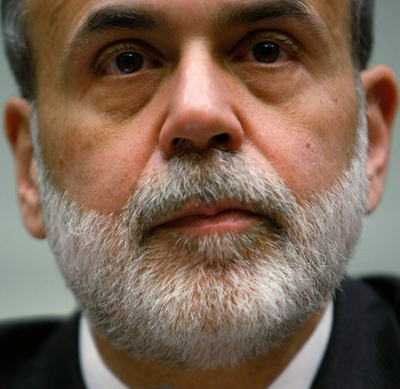 The credit bubble, the recession and what the Federal Reserve should have done ... No, Goldman Sachs did not single-handedly launch the financial crisis, no matter what many lawmakers are saying. The turmoil that struck the markets in 2008 also had very deep roots in another powerful institution: the Federal Reserve. One of the most troubling questions in the aftermath of the crisis is why the Fed didn't intervene to deflate - or "prick" - the credit bubble, especially in home mortgages, before it got so big that its burst would threaten to take down the economy. William Dudley, president of the Federal Reserve Bank of New York, recently suggested that the Fed was mistaken on that score. "The costs of waiting to respond to an asset bubble until after it has burst can be very high," he told the Economic Club of New York. "... A proactive approach is appropriate." While that might seem obvious, it is not the position of either former Fed chairman Alan Greenspan or current central bank chief Ben Bernanke (left). Both continue to defend the Fed's monetary policy in the years prior to the crash - and both have insisted that pricking asset bubbles is not part of the Fed's job. Critics of the Fed have long urged it to intervene in bubbles - an argument that seems even stronger now. - Washington Post