Global solar dominance in sight as science trumps fossil fuels
Ambrose Evans-Pritchard
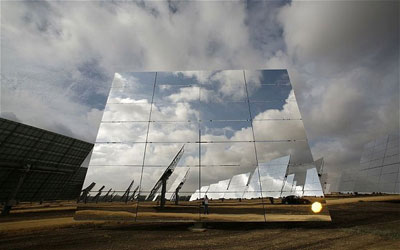 Solar power will slowly squeeze the revenues of petro-rentier regimes in Russia, Venezuela and Saudi Arabia. They will have to find a new business model, or fade into decline Solar power will slowly squeeze the revenues of petro-rentier regimes in Russia, Venezuela and Saudi Arabia. They will have to find a new business model, or fade into decline
Solar power has won the global argument. Photovoltaic energy is already so
cheap that it competes with oil, diesel and liquefied natural gas in much of
Asia without subsidies.
Roughly 29pc of electricity capacity added in America last year came from
solar, rising to 100pc even in Massachusetts and Vermont. "More solar
has been installed in the US in the past 18 months than in 30 years,"
says the US Solar Energy Industries Association (SEIA). California's subsidy
pot is drying up but new solar has hardly missed a beat.
The technology is improving so fast - helped by the US military - that it has
achieved a virtous circle. Michael Parker and Flora Chang, at Sanford
Bernstein, say we entering a new order of "global energy deflation"
that must ineluctably erode the viability of oil, gas and the fossil fuel
nexus over time. In the 1980s solar development was stopped in its tracks by
the slump in oil prices. By now it has surely crossed the threshold
irreversibly.
mm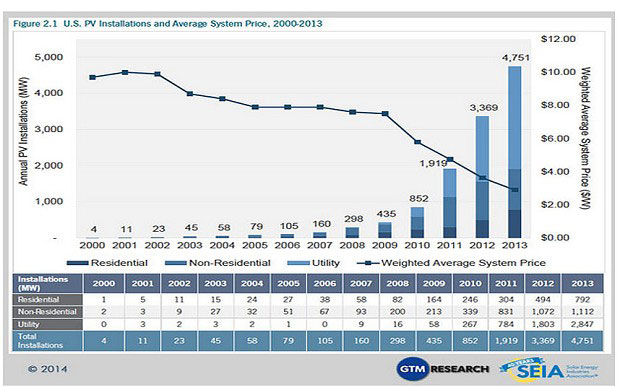
The ratchet effect of energy deflation may be imperceptible at first since
solar makes up just 0.17pc of the world's $5 trillion energy market, or 3pc
of its electricity. The trend does not preclude cyclical oil booms along the
way. Nor does it obviate the need for shale fracking as a stop-gap, for
national security reasons or in Britain's case to curb a shocking current
account deficit of 5.4pc of GDP.
But the technology momentum goes only one way. "Eventually solar will
become so large that there will be consequences everywhere," they said.
This remarkable overthrow of everthing we take for granted in world energy
politics may occur within "the better part of a decade".
If the hypothesis is broadly correct, solar will slowly squeeze the revenues
of petro-rentier regimes in Russia, Venezuela and Saudi Arabia, among
others. Many already need oil prices near $100 a barrel to cover their
welfare budgets and military spending. They will have to find a new business
model, or fade into decline.
The Saudis are themselves betting on solar, investing more than $100bn in 41
gigawatts (GW) of capacity, enough to cover 30pc of their power needs by
2030 rather than burning fossil fuel needed for exports. Most of the Gulf
states have comparable plans. That will mean more crude - ceteris paribus -
washing into a deflating global energy market.
Clean Energy Trends says new solar installations overtook wind turbines
worldwide last year with an extra 36.5GW. China alone accounted for a third.
Wind is still ahead with 2.5 times old capacity but the "solar sorpasso"
will be reached in 2021 as photovoltaic (PV) costs keep falling.
The US National Renewable Energy Laboratory says scientists can now capture
31.1pc of the sun's energy with a 111-V Solar Cell, a world record but soon
to be beaten again no doubt. This will find its way briskly into routine
use. Wind cannot keep pace. It is static by comparison, a regional niche at
best.
A McKinsey study said the average cost of installed solar power in the US
across all sectors has dropped to $2.59 from more than $6 a watt in 2010. It
expects this fall to $2.30 by next year and $1.60 by 2020. This will put
solar within "striking distance" of coal and gas, it said.
Solar cell prices have already collapsed so far that other "soft costs"
now make up 64pc of residential solar installation in the US. Germany has
shown that this too can be slashed, partly by sheer scale.
It is hard to keep up with the cascade of research papers emerging from
brain-trusts in North America, Europe and Japan, so many brimming with
optimism. The University of Buffalo has developed a nanoscale microchip able
to capture a "rainbow" of wavelengths and absorb far more light. A
team at Oxford is pioneering use of perovskite, an abundant material that is
cheaper than silicon and produces 40pc more voltage.
One by one, the seemingly intractable obstacles are being conquered. Israel's
Ecoppia has just begun using robots to clean the panels of its Ketura Sun
park in the Negev desert without the use of water, until now a big
constraint. It is beautifully simple. Soft microfibers sweep away 99pc of
the dust each night with the help of airflows.
Professor Michael Aziz, at Harvard University, is developing a flow-battery
with funding from the US Advanced Research Projects Agency over the next
three years that promises to cut the cost of energy storage by two-thirds
below the latest vanadium batteries used in Japan.
He said the technology gives us a "fighting chance" to overcome the
curse of intermittency from wind and solar power, which both spike and drop
off in bursts. "I foresee a future where we can vastly cut down on
fossil fuel use."
Even thermal solar is coming of age, driven for now by use of molten salts to
store heat and release power hours later. California opened the world's
biggest solar thermal park in February in the Mojave desert - the Ivanpah
project, co-owned by Google and BrightSource Energy - able to produce power
for almost 100,000 homes by reflecting sunlight from 170,000 mirrors onto
boilers that generate electricity from steam. Ivanpah still relies on
subsidies but a new SunPower project in Chile will go naked, selling 70
megawatts into the spot market.
Deutsche Bank say there are already 19 regional markets around the world that
have achieved "grid parity", meaning that PV solar panels can
match or undercut local electricity prices without subsidy: California,
Chile, Australia, Turkey, Israel, Germany, Japan, Italy, Spain and Greece,
for residential power, as well as Mexico and China for industrial power.
This will spread as battery storage costs - often a spin-off from electric car
ventures - keep dropping. Sanford Bernstein says it may not be long before
home energy storage is cheap enough to lure households away from the grid en
masse across the world.
Utilities that fail to adapt fast will face "disaster". Solar
competes directly. Each year it is supplying a bigger chunk of peak power
needs in the middle of the day when air conditioners and factories are both
at full throttle. "Demand during what was one of the most profitable
times of the day disappears," said the report. They cannot raise prices
to claw back lost income. That would merely accelerate what they most fear.
They are trapped.
Michael Liebreich, from Bloomberg New Energy Finance, says we can already
discern the moment of "peak fossil fuels" around 2030, the tipping
point when the world starts using less coal, oil and gas in absolute terms,
but because they cannot compete, not because they are running out.
This is a remarkable twist of history. Just six years ago we faced an oil
shock with crude trading at $148. The rise of "Chindia" and the
sudden inclusion of 2bn consumers into the affluent world seemed to be
taxing resources to breaking point. Now we can imagine how China will fuel
its future fleet of 400m vehicles. Many may be electric, charged by PV
modules.
For Germany it is a bitter-sweet vindication. The country sank €100bn into
feed-in tariffs or in solar companies that blazed the trail, did us all a
favour, and mostly went bankrupt, displaced by copy-cat competitors in
China. The Germans have the world's biggest solar infrastructure, but
latecomers can now tap futuristic technology.
For Britain it offers a reprieve after 20 years of energy drift. Yet the
possibility of global energy deflation raises a quandry: should the country
lock into more nuclear power stations with strike-prices fixed for 35 years?
Should it spend £100bn on offshore wind when imported LNG might be cheaper
long hence?
For the world it portends a once-in-a-century upset of the geostrategic order.
Sheikh Ahmed-Zaki Yamani, the veteran Saudi oil minister, saw the writing on
the wall long ago. "Thirty years from now there will be a huge amount
of oil - and no buyers. Oil will be left in the ground. The Stone Age came
to an end, not because we had a lack of stones, and the oil age will come to
an end not because we have a lack of oil," he told The Telegraph in
2000. Wise old owl.
 Ambrose Evans-Pritchard is International Business Editor of The Daily Telegraph. He has covered world politics and economics for 30 years, based in Europe, the US, and Latin America. He joined the Telegraph in 1991, serving as Washington correspondent and later Europe correspondent in Brussels. Ambrose Evans-Pritchard is International Business Editor of The Daily Telegraph. He has covered world politics and economics for 30 years, based in Europe, the US, and Latin America. He joined the Telegraph in 1991, serving as Washington correspondent and later Europe correspondent in Brussels.
www.telegraph.co.uk |