
Send this article to a friend:
April
14
2014

|
Send this article to a friend: April |
|
Solar Falls Off Cliff, World Domination Inevitable Now
For the record, BI sourced the chart and background information from a note by Michael Parker and Flora Chang of the investment firm AllianceBernstein via its research driven subsidiary Sandford C. Bernstein. The BI article is provocatively titled “The Solar Industry Has Been Waiting 60 Years For This To Happen — And It Finally Just Did.” It’s well worth a read in full but for those of you on the go, here are a couple of tantalizing bits referencing the now-notorious chart. Low Cost Solar
We’ll strongly second that, and add the observation that at least some amount of utility-scale solar, and a practically infinite amount of distributed solar, can be piggybacked on buildings, brownfields, and other sites that have already been built upon. That includes solar windows and other building-integrated solar elements as well as rooftop and ground mounted systems. In that context, it’s easy to see how millions of distributed solar owners will eventually blow up the now-conventional model of an energy harvesting industry dominated by large companies. Here in the US, the Obama Administration has been aggressively pursuing the distributed solar model, both from the foundational research end and through nuts-and-bolts initiatives like the Rooftop Challenge, which is designed to reduce the overall cost of installed solar power. High Cost Fossils
We’ll strongly second that one, too. The basic idea is that as conventional reserves are tapped out, exploration moves to sites that are far more complicated and expensive to access. When you hear that, you naturally think of deep ocean sites, but here in the US you also have two forms of land based fossil fuel extraction, mountaintop removal for coal and fracking for oil and gas, which have undergone a recent boom and are encroaching on populated areas that formerly hosted little or no such activities. So, in addition to the direct cost to fossil fuel companies, we’ll add the cost to communities that host fossil fuel extraction, including poor public health outcomes, economic malaise, and declining property values. Not to pile on, but distributed solar also avoids costs and impacts related to transportation, storage, and byproduct disposal including methane leakage from natural gas pipelines and storage facilities, oil rail car and pipeline disasters, petcoke production, and coal ash spills. The Battery Angle
The article teases out an especially good point here, which is that the explosion of research into EV batteries (that’s another huge Obama Administration initiative, btw) will spill over into the stationary battery market, to the benefit of distributed solar owners:
We’re all over that one, and that’s just as far as direct electrical energy storage goes. The article doesn’t specifically mention solar powered fuel cells, which are already coming into the home market. The basic idea behind the solar powered fuel cells is simple: solar energy is used to split hydrogen from water, which goes to a hydrogen fuel cell. The idea is so simple that researchers are adapting it as a low-cost solar solution for providing electricity to low-usage households in developing countries, as a safer, cheaper alternative to kerosene and other fossil fuels. A Monkey Wrench, Or NotCiting the concerns of AllianceBernstein’s Parker, the article points out that major fossil companies could unleash their reserves now to compete with falling solar prices, which could grind solar development to a temporary halt. We’ll add another unpredictable factor, which is the use of low cost solar energy by fossil companies to offset the rising cost of unconventional fossil extraction methods. Chevron seems to be leading the pack in that area, in partnership with the solar company BrightSource. However, given the latest IPCC report (Intergovernmental Panel on Climate Change), we’re guessing that international policymakers and a growing list of stakeholders in the investment sector will ramp up support the solar industry against competition from an engineered, temporary drop in fossil fuel prices. Follow me on Twitter and Google+.
|
|---|
Send this article to a friend:
 |
 |
 |
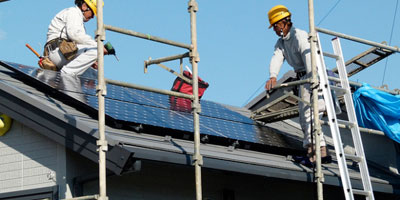 Our friends over at Business Insider have been circulating a chart called Welcome to the Terrordome, which depicts an “almost violent decline in solar pricing” globally, to the point where solar beats oil and liquid natural gas in some markets. As for how much lower solar can go, we’ve been tracking the journey of solar from an exotic space technology to a backyard standard, and BI’s arguments for a solar-dominated world dovetail with our observations.