
Send this article to a friend:
February
17
2014

|
Send this article to a friend: February |
|
Home Energy Storage
Our battery systems are currently offered in selected California markets. We hope to offer the service nationwide by the end of the year. Compact, Safe and Durable SolarCity is making the latest advancements in battery technologies available to you through our partnership with Tesla Motors. Only SolarCity's home backup system uses technology engineered by Tesla, leveraging their expertise in developing battery technologies for premium electric vehicles. Tesla's long history of research and development has enabled a cost-effective, wall-mounted storage appliance that is small, powerful and covered by a long lasting full 10 year warranty. The actual battery unit is about the size of a solar power inverter, and will be mounted on the wall in your garage or near your electrical panel. Be Prepared for Anything Your battery system will provide your home with power if the utility grid goes down—such as after an earthquake or other natural disaster. A fully charged battery will power basic home needs for a few days and a solar powered home can recharge the battery from the sun to run indefinitely.* A fully charged battery provides enough energy for your essential needs during an emergency.
Reduce Your Electric Bill An additional benefit of energy storage is to reduce peak-usage charges on your utility bill. Some utilities offer Time-of-Use (TOU) rate plans in which the price of electricity varies based on the hour of the day. Rates are higher during the afternoon when electric demand is at its "peak" across all utility customers. A storage system may help you save more money by drawing power from your battery instead of from the grid during higher rates peak hours. You can then recharge your battery during lower rate, off-peak hours.
Solar panels are typically installed on the roof and are made up of photovoltaic (PV) cells, which convert sunlight into direct current (DC) power.
Your battery system will provide power to your home in the event of a utility power outage.
The DC power from the solar panels is sent to an inverter, where it is converted into alternating current (AC) power, or standard electrical current used to power your home.
AC power travels from the inverter to the electrical panel, often called a breaker box.
The utility meter continually measures your electrical supply.
Your home remains connected to the utility grid to supply you with electricity when power is available. *Limiting power use to essential devices such as lights and refrigerator. Not all services available in all regions. © 2012 SolarCity. All rights reserved. |
|---|
Send this article to a friend:
 |
 |
 |
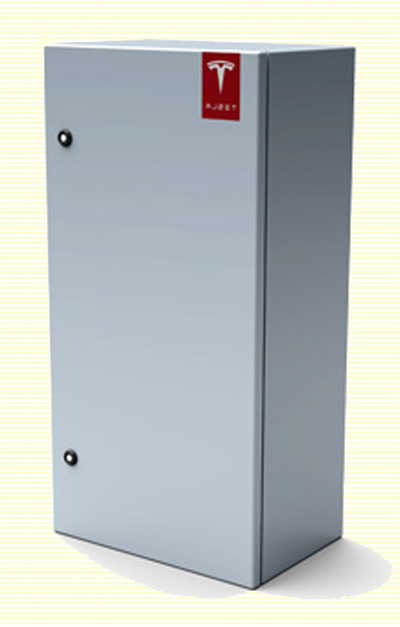 SolarCity's new battery system can help you keep the lights on and fridge cold in a power outage or natural disaster while potentially saving you even more on your monthly utility bills.
 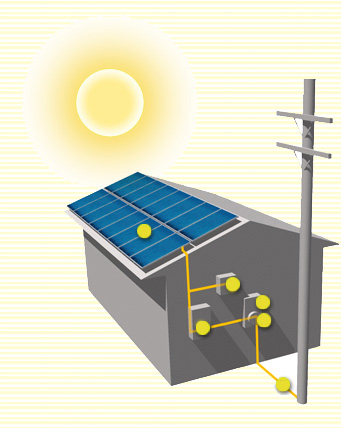 How Home Energy Storage Works
 Solar Panels